

-
1 initial service level
начальный уровень сервиса
Уровень обслуживания на начальном этапе эксплуатации системы, который характеризуется ограниченным набором услуг.
[Л.М. Невдяев. Телекоммуникационные технологии. Англо-русский толковый словарь-справочник. Под редакцией Ю.М. Горностаева. Москва, 2002]Тематики
- электросвязь, основные понятия
EN
Англо-русский словарь нормативно-технической терминологии > initial service level
-
2 level
1. уровень, горизонт 2. нивелир || нивелировать 3. плоская горизонтальная поверхность
level of groundwater уровень грунтовых или подземных вод
level of no strain горизонт, лишённый деформации
level of water table уровень водного зеркала
level of zero amplitude нулевой уровень
Abney level уровень Эбни (ручной уровень с клинометром)
absolute base level абсолютный базис эрозии
accordant summit level равновершинный уровень
basal level базальный горизонт
base level 1. базис эрозии 2. теоретический предел эрозии 3. поверхность, которую стремятся достичь внешние геологические агенты
base level of deposition базис аккумуляции
base level of erosion базис эрозии
base level of stream базис эрозии реки или потока
batter level клинометр
binocular hand level бинокулярный ручной нивелир с уровнем
box level спиртовой уровень
bull's eye level круглый уровень
chambered level камерный уровень
circular level круглый уровень
compensation level уровень компенсации
concordant summit level равновершинный уровень
cross level поперечный уровень
Daly level уровень Дейли
datum level опорный уровень
datum water level уровень воды, принятый за нуль
day level штольня
dead level полный уровень; совершенно ровная поверхность, абсолютная равнина
declining water level сработка уровней подземных вод
deep level глубокий горизонт
drainage level дренажный уровень
dumpy level глухой нивелир (нивелир с закреплённой зрительной грубой)
Egault level нивелир Эго
epeirocratic sea level эпейрократический уровень моря
flood level уровень паводка
fold system level уровень системы складок
free level штольня
freezing level высота нулевой изотермии, уровень замерзания
gallery level горизонт выработки
geodetic sea level средний уровень моря
grade level уровень равновесия
ground level уровень поверхности земли
groundwater level уровень грунтовых или подземных вод
half-tide level средний приливно-отливный уровень
hand level 1. вспомогательный штрек, вспомогательная горизонтальная выработка 2. ручной уровень
higher level верхний уровень, верхний горизонт
high-water level уровень [горизонт] высоких вод
hydrostatic level гидростатический уровень
initial level исходный уровень, нулевая горизонталь
interglacial high sea level высокий уровень моря в межледниковье
intermediate level промежуточный уровень, промежуточный горизонт
isopiestic level изопиестический уровень
isopotential level изопотенциальный уровень
karst base level базис карста
local base level временный базис эрозии
Locke hand level ручной нивелир [уровень] Локке
lower level нижний уровень, нижний горизонт
lowest level of landslide базис оползня
mean land level средний уровень [средняя высота] континентов
mean level of earth's surface средний уровень земной поверхности
mean sea level средний уровень поверхности моря
mean sphere level средний уровень земной поверхности
mean tide level средний приливно-отливный уровень
miner's level нивелир
mining level эксплуатируемый горизонт, этаж
natural level нормальный уровень
normal water level нормальный уровень воды
ordinary tide level средний приливно-отливный уровень
overflow level уровень наводнения
plateau level уровень плато
prism level призматический нивелир
production level продуктивный [эксплуатируемый] горизонт
recurrence level повторяющийся горизонт
reference level отсчётный [нулевой, исходный] уровень
rise level верхний уровень, верхний горизонт
river base level базис эрозии реки
sea level уровень моря
service level рабочий горизонт
set level направление уровня, направление горизонта
sphere level уровень земной коры
spirit level спиртовой уровень
standing (water) level стоячий уровень воды
static level статический уровень
stationary sea level неизменный [постоянный] уровень моря
striding level 1. спиртовой уровень, расположенный выше горизонтальной оси съёмочного инструмента 2. съёмный спиртовой уровень для определения горизонтальной линии визирования
summit level 1. наибольшая высотная отметка 2. уровень вершинной поверхности
surface level уровень поверхности, поверхностный уровень
surveyor's level 1. нивелир 2. горизонт рудника, на котором производится съёмка или изучение рудного тела
temporary base level временный базис эрозии
thalassocratic sea level талассократический уровень моря (максимальный относительный уровень моря)
trapping level уровень захвата
ultimate base level предельный базис эрозии
upper level верхний уровень, верхний горизонт
water level 1. ватерпас 2. уровень воды 3. уровень грунтовых вод, водное зеркало
wye [у] level нивелир с перекладной трубой
zero water level нулевой уровень воды, ординар
* * *• горизонт• дорожка• откос• склон• срез• эшелон -
3 level
2.ровный, горизонтальный3.ватерпас, нивелир || нивелировать— see level— upper water level -
4 level
1) ватерпас, уровень || выверять по уровню2) уровень, степень, ступень; интенсивность3) уровень, высотная отметка || устанавливать уровень4) физ. энергетический уровень5) равнина6) горизонтальный || горизонтировать7) авиац. горизонтальный полёт || лететь горизонтально8) нивелир || нивелировать9) заравнивать; выравнивать; разравнивать10) ровный, плоский•above a ground level — над уровнем земли; выше нулевой отметки
at a ground level — на нулевой отметке;
hunting for a level — телефон. искание декады
hunting within a level — телефон. искание в декаде
with wings level — авиац. без крена
to level off — выравнивать; распрямлять; спрямлять
to occupy a level — физ. занимать (соответствующий) энергетический уровень
to reside at level — физ. находиться на энергическом уровне
- median significance level - minimum safe level - nominal significance level - optimum factor level - preset level - tolerable level - tolerance levelto set up a level — устанавливать нивелир; задавать уровень
-
5 premium
1. сущ.сокр. prem1) общ. награда, вознаграждение, премия (что-л. предоставляемое в качестве стимула в каком-л. проекте, какой-л. системе и пр.)consumer premium — подарок [премия\] потребителю*
The program will award points to consumers for each brewery visit during the week, allowing them to earn premiums such as beer mugs and logo shirts.
Mortgage brokers, who match borrowers with lenders, can earn premiums by steering borrowers to higher-rate loans.
They claim that lenders on the higher-than-market rate loans will pay a premium to the mortgage broker and that those payments will be used to pay the fees associated with the low-interest loans.
See:bonus 1), 2) advertising premium, consumer premium, container premium, employment premium, fast food premium, free-in-the-mail premium, in-pack premium, mail-in premium, on-pack premium, referral premium, reverse premium, self-liquidating premium, service release premium, with-pack premium, yield spread premium, premium bond 2), premium buyer 1), premium campaign, premium container, premium coupon, premium merchandise 1), premium offer, premium pack, premium product 2), premium service 1) а)2) страх. = insurance premiumATTRIBUTES: adjustable, assumed 3) а), base 3. 3) а), direct 1. 3) а), earned 1. 1) а), fixed 1. 4) а), flexible 1. 2) б), gross 1. 3) а), а initial 1. 2) б), level 2. 3) б), lump sum, net 3. 3) а), n1а outstanding 1. 3) а), periodic 1. 1) а), regular 1. 2) б), n2 subject 1. 2) б), n2 underlying 1. 2) б), n2 variable 1. 2) б), n2 written 1. 4) а), б
annual [yearly\] premium — ежегодная премия
monthly [biweekly, weekly\] premium — ежемесячная [двухнедельная, еженедельная\] премия
annual [monthly, weekly\] premium insurance — страхование с ежегодной [ежемесячной, еженедельной\] уплатой премий [премии\]
annual premium policy — полис с ежегодной уплатой премий [премии\]
ATTRIBUTES:
paid premium — уплаченная [выплаченная\] премия
The refund of paid premium is based on the insured's age at death and is decreased by any benefits paid under the plan.
Company-paid premiums are deductible by the employer as an ordinary and necessary business expense. — Уплаченные компанией премии подлежат вычету работодателем как обычные и необходимые деловые расходы.
For federal tax purposes the employer-paid premiums are taxed as additional earned income for the employee. — Для целей федерального налогообложения, уплаченные работодателем премии облагаются налогом как дополнительный заработанный доход работника.
Employee-paid premiums for health insurance vary by salary. — Размер уплачиваемых работником премий по страхованию здоровья меняется в зависимости от размера оклада.
We can recover overpaid premiums for the last three policy years.
unpaid premium — неуплаченная [невыплаченная\] премия
The late charge formula is the unpaid premium amount multiplied by four percent.
COMBS:
life insurance premiums, life premiums — премии по страхованию жизни
non-life insurance premiums, non-life premiums — премии по страхованию иному, чем страхование жизни; премии по страхованию "не жизни"
health insurance premiums, health premiums — премии по страхованию здоровья
liability insurance premiums, liability premiums — премии по страхованию ответственности
disability insurance premiums, disability premiums — премии по страхованию от [на случай\] нетрудоспособности
property insurance premiums, property premiums — премии по страхованию имущества
premium payment — уплата [выплата\] премии; премиальный платеж
Mortgage insurance premium payments are made once per year. — Выплаты премий по ипотечному страхованию осуществляются раз в год.
premium of $1000, $1000 premium — премия [надбавка\] в размере 1000 долл.
Our commercial premium finance program allows you to finance premiums from $0 to $200000 or more.
The policies in question have a waiver of premium benefit, whereby the insurer would waive premiums during any period in which the policyholder is disabled.
We cede premiums and losses to reinsurers under quota share reinsurance agreements. — Мы передаем премии и убытки перестраховщиками на основании договоров квотного перестрахования.
Also, under our quota share assumed reinsurance contracts, we will continue to assume premiums through the third quarter of 2006. — Также, на основании принятых договоров квотного перестрахования, мы будем продолжать принимать премии на протяжении третьего квартала 2006 г.
to write premiums — подписывать премии*; страховать*, принимать на страхование*, осуществлять страхование*
In general, for insurers to write premiums in California, they must be admitted by the Insurance Commissioner. — В общем, для того, чтобы страховщики смогли осуществлять страховую деятельность в Калифорнии, они должны получить разрешение уполномоченного по страхованию.
The company is licensed to write insurance business in all 50 states, has specialty lines in risk insurance for architects and lawyers and is expected to write premiums of $75 million this year. — Компания имеет лицензию на осуществление страховой деятельности во все 50 штатах, предлагает специальные разновидности страхования рисков для архитекторов и юристов и, как ожидается, подпишет в этом году премий на сумму 75 млн долл.
Moreover, an insurance company that earns premiums between $300,000 and $1,000,000 is taxed at a reduced rate.
If you want to pay premiums for a limited time, the limited payment whole life policy gives you lifetime protection but requires only a limited number of premium payments.
to raise [to increase\] premiums — увеличивать премии
to reduce [to decrease, to cut\] premiums — уменьшать премии
premiums go down — премии снижаются [уменьшаются\]
See:adjustable premium, advance premium, annual premium, annuity premium, base premium, beneficiary premium, deposit premium, direct premiums, earned premium, financed insurance premium, financed premium, fixed premium, flexible premium, graded premium, gross premium, in-force premiums, initial premium, level premium, lump sum premium, modified premium, mortgage insurance premium, net premium, net retained premiums, new business premiums, outstanding premiums, periodic premium, premium earned, premiums in force, premium written, regular premium, reinsurance premium, renewal premium, retained premiums, retrospective premium, return premium, single premium, subject premium, surplus line premium, surplus lines premium, underlying premium, unearned premium, valuation premium, vanishing premium, variable premium, written premium, yearly premium, overall premium limit, premium audit, premium auditor, premium base, premium bordereau, premium conversion, premium discount, premium financing, premium holiday, premium income б), premium loan, premium notice, premium rate 1) б), premium receipt, premium refund, premium subsidy, premium tax, premium trust fund, return of premium, waiver of premium, continuous-premium whole life, premium only plan, premium-to-surplus ratio3)а) торг. премия; наценка, надбавка ( сумма или процент сверх стандартной цены товара или услуги)to fetch a premium [a premium price\] — продаваться с надбавкой [с премией\]
Premium products generally fetch a premium price. — Премиальные товары обычно продаются с надбавкой [с премией\].
to command a premium [a premium price\] — продаваться с надбавкой [с премией\], продаваться по премиальной цене
Some products command a premium price in the marketplace simply because they are considered to be higher in quality. — Некоторые товары продаются на рынке по премиальной цене просто из-за того, что они считаются товарами более высокого качества.
to command a premium — содержать надбавку [премию\]* (о ценах, ставках)
As long as there is a threat of war in the Middle Eastern oil fields, oil prices will command a premium. — До тех пор, пока существует угроза войны на территории средневосточных нефтяных месторождений, цены на нефть будут содержать надбавку.
to attract a premium/a premium price/a premium rate — продаваться с премией [надбавкой\], стоить дороже; оплачиваться с надбавкой [с премией\]*
Because of their locations these houses attract a premium. — Благодаря своему расположению эти дома стоят дороже.
Therefore, when we buy your diamond, we can pay a premium over the current market price.
For which services are customers willing to pay a premium when flying with a low-fare airline?
Ant:call option premium, call premium 2), put option premium, put premium, premium deal, premium income а) contingent premium option, deferred premium optionSee:б) фин. премия (сумма, на которую цена размещения или текущая рыночная цена ценной бумаги больше ее номинала)ATTRIBUTES: amortizable б)
COMBS:
$20-a-share premium — премия в размере $20 на (одну) акцию
H-P will buy 1,2 million Convex shares at $14.875 a share, representing a 1,25-a-share premium over the price of Convex stock. — "H-P" купит 1,2 млн акций компании "Конвекс" по цене 14,875 долл. за штуку, что означает уплату премии в размере 1,25 долл. на акцию сверх цены акций "Конвекса".
COMBS:
premium over [to\] market price — премия к рыночной цене, премия сверх рыночной цены
premium over [to\] issue price — премия к эмиссионной цене, премия сверх эмиссионной цены
premium payment — уплата [выплата\] премии; премиальный платеж
Mortgage insurance premium payments are made once per year. — Выплаты премий по ипотечному страхованию осуществляются раз в год.
premium of $1000, $1000 premium — премия [надбавка\] в размере 1000 долл.
10% premium, premium of 10% — премия [надбавка\] в размере 10%
The shares jumped to a 70 per cent premium on the first day.
Of all the common bond-tax errors, the most surprising to me is neglecting to amortize premiums paid on taxable bonds.
For premium securities, we project the excess coupon. payments using our prepayment assumption.
Ant:call option premium, call premium 2), put option premium, put premium, premium deal, premium income а) contingent premium option, deferred premium optionSee:amortized premium, bond premium, call premium 1), debt premium 1) а), market premium 1) а), original issue premium, premium on capital stock, premium on share, premium on stock, price premium 1) б), redemption premium, share premium, tender offer premium, unamortized premium, amortization of premium, premium bond 1), premium price 1) б), premium raid, issue price, market price, face value а) at a premium 1) а)в) фин. премия (при оценке стоимости предприятия или крупных пакетов акций: разница, на которую фактически согласованная цена предприятия/пакета акций больше базовой рыночной цены)See:г) эк. премия; надбавка (сумма, на которую цена товара, услуги или ценной бумаги превышает цену сходного товара, услуги или ценной бумаги)Currently, US small caps are trading at a 15.7 per cent premium to large caps. — В настоящее время, акции американских компаний с маленькой капитализацией по сравнению с акциями компаний с большой капитализацией торгуются с премией в размере 15,7%.
Platinum usually trades at a premium to gold. — Платина обычно продается по более высокой цене, чем золото.
See:at a premium 1)д) фин. ажио (превышение стоимости золотых или серебряных денег по сравнению с бумажными деньгами)Syn:agio в)See:е) эк. премия; надбавка (в самом общем смысле: дополнительная сумма, на которую увеличена базовая стоимость или другая базовая величина)перен. to put [place\] a premium on (smth.) — считать (что-л.) исключительно важным [ценным\], придавать (чему-л.) большое значение
He put a premium on peace and stability. — Он считает исключительно важным поддержание мира и стабильности.
Employers today put a premium on reasoning skills and willingness to learn. — В наше время работодатели придают большое значение умению рассуждать и готовности учиться.
Ant:call option premium, call premium 2), put option premium, put premium, premium deal, premium income а) contingent premium option, deferred premium optionSee:conversion premium, forward premium, inflation premium, investment currency premium, liquidity premium 2), 3), mortgage indemnity guarantee premium, mortgage indemnity premium, premium over conversion value, revenue premium, risk premium, time premium, union premium, union wage premium, warrant premium, yield premium, premium rate 1) а) at a premium 2), Canada Premium Bond, high-premium convertible debenture4) эк. тр. премия, (премиальная) надбавка (дополнительное вознаграждение, выплачиваемое в дополнение к заработной плате в качестве поощрения за хорошую работу, работу в сверхурочные и т. п.)COMBS:
premiums for work outside basic workday or workweek — премии за работу сверх базового рабочего дня или рабочей недели
premium payment — уплата [выплата\] премии; премиальный платеж
premium of $1000, $1000 premium — премия [надбавка\] в размере 1000 долл.
to attract a premium/a premium rate — оплачиваться с надбавкой [с премией\]*
In many industries work on Saturday or Sunday will attract a premium on the ordinary hourly rate. — Во многих отраслях работа в субботу или воскресенье предусматривает выплату надбавки сверх обычной часовой ставки.
Neither federal law nor state law requires local government employers to give employees paid holidays or to pay a premium when employees must work on what would otherwise be a holiday.
Syn:bonus 3)See:expatriate premium, foreign service premium, holiday premium, incentive premium, mobility premium, on-call premium, overtime premium, shift premium, Halsey premium plan, premium pay, premium rate 1) а)5) фин. = option premiumInvestors willing to buy stock at certain prices might consider selling puts to earn premiums, while those willing to sell shares at certain prices might think about selling calls.
When you purchase an option, you pay a premium. — Покупая опцион, вы уплачиваете премию.
See:call option premium, call premium 2), put option premium, put premium, premium deal, premium income а) contingent premium option, deferred premium option2. прил.1) общ. первосортный, высшего качества [сорта\], исключительный, премиальныйpremium product — премиальный товар, товар высшего сорта
premium card — первоклассная [приоритетная, премиальная\] карта [карточка\]*
premium space — привилегированное [премиальное\] место*
premium advertising — премиальная [первосортная, элитная\] реклама*
premium customer — премиальный клиент [покупатель\]*
premium quality — премиальное [высшее\] качество; премиальный [высший\] сорт
premium grade — премиальный [высший\] сорт
See:premium advertising, premium buyer 2), premium card, premium customer, premium grade, premium merchandise 2), premium position, premium product 1), premium quality, premium service 1) б), premium space, quality 2., inferior 2., n32) эк. премиальный, с премией, с надбавкой (о ценах, ставках выше обычного уровня)premium price — цена с надбавкой, цена с премией, премиальная цена
See:
* * *
premium; PM; Prem премия, маржа: 1) премия (надбавка) к цене, курсу: разница между более высокой текущей (рыночной) и номинальной ценами финансового актива (напр., облигации); см. discount; 2) разница между более высоким срочным (форвардным) и наличным валютными курсами, т. е. валюта на срок продается с премией; 3) ажио: более высокая стоимость золотых или бумажных денег по отношению к бумажным деньгам; 4) цена опциона: сумма, уплачиваемая за получение права продать или купить финансовый инструмент; 5) = insurance premium; 6) платеж по рентному контракту; 7) = call premium; 8) льгота, призванная привлечь вкладчиков или заемщиков, а также покупателей товаров и услуг (напр., повышенная процентная ставка, скидки с цен и др.); 9) надбавка к рыночной цене, которую иногда приходится уплачивать при заимствованиях ценных бумаг для их поставки по "короткой" продаже; 10) разница в цене между данной ценной бумагой и сходными бумагами или индексом (напр., говорят: "бумага продается с премией к аналогичным бумагам"); 11) новая ценная бумага, продающаяся с премией; 12) надбавка к рыночной цене ценных бумаг в случае тендерного предложения; см. premium raid;* * *Финансы/Кредит/Валютаотклонение в сторону превышения рыночного курса денежных знаков и ценных бумаг от их нарицательной стоимости-----разница между рыночной ценой и ценой эмиссии акции или ценной бумаги; при начале операции с акциями нового выпуска говорится, что рыночная цена включает премию по отношению к цене эмиссии-----сумма, выплачиваемая держателем полиса для получения страховой суммы в нужный момент-----Банки/Банковские операциипремия, вознаграждение, надбавка -
6 training
( боевая) подготовка; обучение; тренировка; наведениеship-based training (for assault landing) — десантная подготовка совместно с кораблями и плавучими средствами
— career enhancing training— common-track training— continental US training— cross-rate training— gunnery-oriented training— hand-to-hand combat training— intra-unit training— joint service training— nuclear weapon training— physical readiness training— reserve cycle training— resident school training— rifle marksmanship training— systems specific training -
7 of
acknowledgement of receiptподтверждение приемаactual time of arrivalфактическое время прибытияaerodrome of callаэродром выхода на радиосвязьaerodrome of departureаэродром вылетаaerodrome of intended landingаэродром предполагаемой посадкиaerodrome of originаэродром припискиaircraft center - of - gravityцентровка воздушного суднаairport of departureаэропорт вылетаairport of destinationаэропорт назначенияairport of entryаэропорт прилетаallocation of dutiesраспределение обязанностейallocation of frequenciesраспределение частотallotment of frequenciesвыделение частотalternative means of communicationрезервные средства связиamount of controlsстепень использованияamount of feedbackстепень обратной связиamount of precipitationколичество осадковangle of allowanceугол упрежденияangle of approachугол захода на посадкуangle of approach lightугол набора высотыangle of ascentугол набора высотыangle of attackугол атакиangle of climbугол набора высотыangle of coverageугол действияangle of crabугол сносаangle of descentугол сниженияangle of deviationугол отклоненияangle of dipугол магнитного склоненияangle of diveугол пикированияangle of downwashугол скоса потока внизangle of elevationугол местаangle of exitугол сходаangle of glideугол планированияangle of incidenceугол атакиangle of indraftугол входа воздушной массыangle of lagугол отставанияangle of landingпосадочный уголangle of pitchугол тангажаangle of rollугол кренаangle - of - sideslip transmitterдатчик угла скольженияangle of sightугол прицеливанияangle of slopeугол наклона глиссадыangle of stallугол сваливанияangle of turnугол разворотаangle of upwashугол скоса потока вверхangle of visibilityугол обзораangle of yawугол рысканияantimeridian of Greenwichмеридиан, противоположный Гринвичскомуapparent drift of the gyroкажущийся уход гироскопаapplication of tariffsприменение тарифовapproach rate of descentскорость снижения при заходе на посадкуarc of a pathдуга траекторииarc of equal bearingsдуга равных азимутовarea of coverageзона действияarea of coverage of the forecastsрайон обеспечения прогнозамиarea of occurenceрайон происшествияarea of responsibilityзона ответственностиarrest the development of the stallпрепятствовать сваливаниюassessment of costsустановление размеров расходовassignment of dutiesраспределение обязанностейAssociation of European AirlinesАссоциация европейских авиакомпанийAssociation of South Pacific AirlinesАссоциация авиакомпаний южной части Тихого океанаassumption of control messageприем экипажем диспетчерского указанияat a speed ofна скоростиat the end ofв конце циклаat the end of segmentв конце участка(полета) at the end of strokeв конце хода(поршня) at the start of cycleв начале циклаat the start of segmentв начале участка(полета) aviation-to-aviation type of interferenceпомехи от авиационных объектовavoidance of collisionsпредотвращение столкновенийavoidance of hazardous conditionsпредупреждение опасных условий полетаaxial of bankпродольная осьaxis of precessionось прецессии гироскопаaxis of rollпродольная осьaxis of rotationось вращенияaxis of yawвертикальная осьbackward movement of the stickвзятие ручки на себяbe out of trimбыть разбалансированнымbest rate of climbнаибольшая скороподъемностьbias out of viewвыходить из поля зренияbill of entryтаможенная декларацияbill of ladingгрузовая накладнаяblanketing of controlsзатенение рулейbody of compass cardдиск картушки компасаboundary of the areaграница зоныBureau of Administration and ServicesАдминистративно-хозяйственное управлениеcamber of a profileкривизна профиляcare of passengersобслуживание пассажировcarriage of passengersперевозка пассажировcarry out a circuit of the aerodromeвыполнять круг полета над аэродромомcause of aircraft troubleпричина неисправности воздушного суднаcenter of air pressureцентр аэродинамического давленияcenter of depressionцентр низкого давленияcenter of forceцентр приложения силыcenter of gravityцентр тяжестиcenter of massцентр массcenter of pressureцентр давленияCentral Agency of Air ServiceГлавное агентство воздушных сообщенийcertificate of revaccinationсертификат ревакцинацииcertificate of safety for flightсвидетельство о допуске к полетамcertificate of vaccinationсертификат вакцинацииchoice of fieldвыбор посадочной площадкиclass of liftкласс посадкиclearance of goodsтаможенное разрешение на провозclearance of obstaclesбезопасная высота пролета препятствийclearance of the aircraftразрешение воздушному суднуcoefficient of heat transferкоэффициент теплопередачиcome clear of the groundотрываться от землиcomplex type of aircraftкомбинированный тип воздушного суднаcomposition of a crewсостав экипажаconcept of separationэшелонированиеconditions of carriageусловия перевозокcone of raysпучок лучейcongestion of informationнасыщенность информацииcontinuity of guidanceнепрерывность наведенияcontour of perceived noiseконтур воспринимаемого шумаcontrol of an investigationконтроль за ходом расследованияcorrelation of levelsприведение эшелонов в соответствиеcountry of arrivalстрана прилетаcountry of originстрана вылетаcourse of trainingкурс подготовкиcoverage of the chartкартографируемый районcurve of equal bearingsлиния равных азимутовdanger of collisionsопасность столкновенияdegree of accuracyстепень точностиdegree of freedomстепень свободыdegree of skillуровень квалификацииdegree of stabilityстепень устойчивостиdenial of carriageотказ в перевозкеDepartment of TransportationМинистерство транспортаderivation of operating dataрасчет эксплуатационных параметровdetermination of causeустановление причиныdetermine amount of the errorопределять величину девиацииdetermine the extent of damageопределять степень поврежденияdetermine the sign of deviationопределять знак девиацииdevelopment of the stallпроцесс сваливанияdirection of approachнаправление захода на посадкуdirection of rotationнаправление вращенияdirection of turnнаправление разворотаduration of noise effectпродолжительность воздействия шумаelevation of the stripпревышение летной полосыelevation setting of light unitsустановка углов возвышения глиссадных огнейeliminate the cause ofустранять причинуeliminate the source of dangerустранять источник опасности(для воздушного движения) end of runwayначало ВППenforce rules of the airобеспечивать соблюдение правил полетовen-route change of levelизменение эшелона на маршрутеerection of the gyroвосстановление гироскопаestimated position of aircraftрасчетное положение воздушного суднаestimated time of arrivalрасчетное время прибытияestimated time of departureрасчетное время вылетаestimated time of flightрасчетное время полетаeven use of fuelравномерная выработка топливаextension of ticket validityпродление срока годности билетаextent of damageстепень поврежденияfacilitate rapid clearance ofобеспечивать быстрое освобождениеfactor of safetyуровень безопасностиfiling of statistical dataпредставление статистических данныхfirst freedom of the airпервая степень свободы воздухаfirst type of occurenceпервый тип событияflow of air trafficпоток воздушного движенияfly under the supervision ofлетать под контролемfor reasons of safetyв целях безопасностиfreedom of actionсвобода действийfreedom of the airстепень свободы воздухаfrequency of operationsчастота полетовgathering of informationсбор информацииgeneral conditions of carriageосновные условия перевозкиGeneral Conference of Weights and MeasureГенеральная конференция по мерам и весамGeneral Department of International Air Services of AeroflotЦентральное управление международных воздушных сообщений гражданской авиацииget out of controlтерять управлениеgiven conditions of flightзаданные условия полетаgo out of controlстановиться неуправляемымgo out of the spinвыходить из штопораgrade of serviceкатегория обслуживанияgrade of the pilot licenceкласс пилотского свидетельстваgrading of runwayнивелирование ВППheight at start of retractionвысота начала уборкиhover at the height ofзависать на высотеidentification of signalsопознавание сигналовinconventional type of aircraftнестандартный тип воздушного суднаincrease a camber of the profileувеличивать кривизну профиляindication of a requestобозначение запросаin interests of safetyв интересах безопасностиinitial rate of climbначальная скороподъемностьinitial stage of go-aroundначальный участок ухода на второй кругinlet angle of attackугол атаки заборного устройстваintake angle of attackугол атаки воздухозаборникаintegrated system of airspace controlкомплексная система контроля воздушного пространстваinterception of civil aircraftперехват гражданского воздушного суднаInternational Co-ordinating Council of Aerospace Industries AssociationМеждународный координационный совет ассоциаций авиакосмической промышленностиInternational Council of Aircraft Owner and Pilot AssociationsМеждународный совет ассоциаций владельцев воздушных судов и пилотовInternational Federation of Air Line Pilots' AssociationsМеждународная федерация ассоциаций линейных пилотовInternational Federation of Air Traffic Controllers' AssociationsМеждународная федерация ассоциаций авиадиспетчеровInternational Relations Department of the Ministry of Civil AviationУправление внешних сношений Министерства гражданской авиацииinterpretation of the signalрасшифровка сигналаinterpretation of weather chartчтение метеорологической картыintersection of air routesпересечение воздушных трассin the case of delayв случае задержкиin the event of a mishapв случае происшествияin the event of malfunctionв случая отказаintroduction of the correctionsввод поправокkeep clear of rotor bladesостерегаться лопастей несущего винтаkeep clear of the aircraftдержаться на безопасном расстоянии от воздушного суднаkeep out of the wayне занимать трассуlayout of aerodrome markingsмаркировка аэродромаlayout of controlsрасположение органов управленияlessee of an aircraftарендатор воздушного суднаlevel of airworthinessуровень летной годностиlevel of safetyуровень безопасностиlevel of speech interferenceуровень помех речевой связиlimiting range of massпредел ограничения массыline of flightлиния полетаline of positionлиния положенияline of sightлиния визированияlocation of distressрайон бедствияloss of controlпотеря управленияloss of pressurizationразгерметизацияloss of strengthпотеря прочностиmagnetic orientation of runwayориентировка ВПП по магнитному меридиануmargin of errorдопуск на погрешностьmargin of liftзапас подъемной силыmargin of safetyдопустимый уровень безопасностиmargin of stabilityзапас устойчивостиmarking of pavementsмаркировка покрытияmean scale of the chartсредний масштаб картыmeans of communicationсредства связиmeans of identificationсредства опознаванияmeridian of Greenwichгринвичский меридианmethod of steepest descentспособ резкого сниженияmode of flightрежим полетаmoment of inertiaмомент инерцииmoment of momentumмомент количества движенияname-code of the routeкодирование названия маршрутаonset of windрезкий порыв ветраoperation of aircraftэксплуатация воздушного суднаout of ground effectвне зоны влияния землиout of serviceизъятый из эксплуатацииovershoot capture of the glide slopeпоздний захват глиссадного лучаperiod of rating currencyпериод действия квалифицированной отметкиpersonal property of passengersличные вещи пассажировpilot's field of viewполе зрения пилотаplane of rotationплоскость вращенияplane of symmetry of the aeroplaneплоскость симметрии самолетаpoint of arrivalпункт прилетаpoint of callпункт выхода на связьpoint of departureпункт вылетаpoint of destinationпункт назначенияpoint of discontinuityточка разрываpoint of intersectionточка пересеченияpoint of loadingпункт погрузкиpoint of no returnрубеж возвратаpoint of originпункт вылетаpoint of turn-aroundрубеж разворотаpoint of unloadingпункт выгрузкиportion of a flightотрезок полетаportion of a runwayучасток ВППprevention of collisionsпредотвращение столкновенийprimary element of structureосновной элемент конструкцииprohibition of landingзапрещение посадкиprolongation of the ratingпродление срока действия квалификационной отметкиpromotion of safetyобеспечение безопасности полетовproof of complianceдоказательство соответствияpropagation of soundраспространение шумаprotection of evidenceсохранение вещественных доказательствpull out of the spinвыводить из штопораpull the aircraft out ofбрать штурвал на себяradar transfer of controlпередача радиолокационного диспетчерского управленияradius of curvatureрадиус кривизныrange of coverageрадиус действияrange of motionдиапазон отклоненияrange of revolutionsдиапазон оборотовrange of visibilityдальность видимостиrange of visionдальность обзораrate of climbскороподъемностьrate of closureскорость сближенияrate of descentскорость сниженияrate of disagreementскорость рассогласованияrate of dutyскорость таможенной пошлиныrate of exchangeкурс обмена валютыrate of flaps motionскорость отклонения закрылковrate of growthтемп ростаrate of pitchскорость по тангажуrate of rollскорость кренаrate of sideslipскорость бокового скольженияrate of trimскорость балансировкиrate of turnскорость разворотаrate of yawскорость рысканияreception of telephonyприем телефонных сообщенийrecord of amendmentsлист учета поправокrecord of revisionsвнесение поправокregularity of operationsрегулярность полетовrelay of messagesпередача сообщенийrelease of controlпередача управленияremoval of aircraftудаление воздушного суднаremoval of limitationsотмена ограниченийreplacement of partsзамена деталейrepresentative of a carrierпредставитель перевозчикаreservation of a seatбронирование местаretirement of aircraftсписание воздушного суднаright - of - entryпреимущественное право входаroll out of the turnвыходить из разворотаrules of the airправила полетовsafe handling of an aircraftбезопасное управление воздушным судномsecond freedom of the airвторая степень свободы воздухаsecond type of occurenceвторой тип событияselection of engine modeвыбор режима работы двигателяsequence of fuel usageочередность выработки топлива(по группам баков) sequence of operationпоследовательность выполнения операцийshowers of rain and snowливневый дождь со снегомsimultaneous use of runwaysодновременная эксплуатация нескольких ВППsite of occurrenceместо происшествияslope of levelнаклон кривой уровня(шумов) source of dangerисточник опасностиStanding Committee of PerformanceПостоянный комитет по летно-техническим характеристикамstart of leveloffначало выравниванияstart of takeoffначало разбега при взлетеstate of aircraft manufactureгосударство - изготовитель воздушного суднаstate of dischargeстепень разряженности(аккумулятора) state of emergencyаварийное состояниеstate of occurenceгосударство места событияstate of transitгосударство транзитаsteadiness of approachустойчивость при заходе на посадкуsteady rate of climbустановившаяся скорость набора высотыstructure of frontsструктура атмосферных фронтовsubmission of a flight planпредставление плана полетаsystem of monitoring visual aidsсистема контроля за работой визуальных средств(на аэродроме) system of unitsсистема единиц(измерения) table of cruising levelsтаблица крейсерских эшелоновtable of intensity settingsтаблица регулировки интенсивностиtable of limitsтаблица ограниченийtable of toleranceтаблица допусковtake out of serviceснимать с эксплуатацииtarget level of safetyзаданный уровень безопасности полетовtemporary loss of controlвременная потеря управляемостиtermination of controlпрекращение диспетчерского обслуживанияtheory of flightтеория полетаtime of lagвремя запаздыванияtime of originвремя отправленияtitl of the gyroзавал гироскопаtop of climbконечный участок набора высотыtransfer of controlпередача диспетчерского управленияtransmission of telephonyпередача радиотелефонных сообщенийtransmit on frequency ofвести передачу на частотеtriangle of velocitiesтреугольник скоростейunder any kind of engine failureпри любом отказе двигателяuneven use of fuelнеравномерная выработка топливаunit of measurementединица измеренияvelocity of soundскорость звукаwall of overpressureфронт избыточного давленияwarn of dangerпредупреждать об опасностиwithin the frame ofв пределахworking language of ICAOрабочий язык ИКАОzone of intersectionзона пересеченияzone of silenceзона молчания -
8 school
Civil Affairs Administration [Training] school — школа [училище] специалистов по связям с гражданской администрацией и населением
jungle warfare (training) school — школа [курсы] подготовки (ЛС) для действий в джунглях
small arms (firing) school — школа [курсы] стрелковой подготовки
— administrative service school— basic-level service school— career-level service school— gunnery training school— intermediate-level service school— military training school— NBC defense school— top-level service school -
9 pressure
давление; пластовое давление; усилие; напор; напряжение; сжатиеpressure above the atmospheric — давление выше атмосферного; манометрическое [избыточное] давление, сверхдавление
pressure applied at the surface — давление, создаваемое на устье скважины
pressure at the economic level — давление, определяемое экономичностью разработки
pressure on the bit — давление на долото, нагрузка на долото
* * *
давление; пластовое давление
* * *
1) давление2) интенсивная эксплуатация, переэксплуатация ( природных ресурсов) скважины•pressure applied at surface — давление, создаваемое на устье скважины;
pressure at economic level — давление, определяемое экономичностью обработки;
pressure at well bore — забойное давление;
pressure in place — давление в залежи;
pressure in reservoir — давление в залежи;
pressure on bit — давление на долото, нагрузка на долото;
pressure on intake side of pump — давление на входе в насос;
pressure per diamond — удельное давление на один алмаз;
to keep up pressure — поддерживать давление;
to maintain pressure — поддерживать давление;
to offset formation pressure — создавать противодавление на пласт;
- abandonment pressureto pressure up — проверять плотность соединений перед кислотной обработкой; опрессовывать
- abnormal formation pressure
- abnormal gas pressure
- abnormal pore pressure
- abnormal reservoir pressure
- abnormal rock pressure
- abnormal well pressure
- abnormally high pressure
- above bubble point pressure
- absolute formation pressure
- absolute reservoir pressure
- absolute wellhead pressure
- annular friction pressure
- annulus pressure
- anomalously high pore pressure
- applied pressure
- areal average pressure
- atmospheric pressure
- available pressure
- average flowing pressure
- average reservoir pressure
- average unit pressure
- back pressure
- barometric pressure
- bit pressure
- boost pressure
- borehole pressure
- bottom-loading pressure
- bottomhole pressure
- bottomhole circulating pressure
- bottomhole differential pressure
- bottomhole flowing pressure
- bottomhole shut-in pressure
- breakdown pressure
- bubble-point pressure
- bubble-point pressure of reservoir oil
- bursting pressure
- casing pressure
- casing-burst pressure
- casing-head pressure
- charging pressure
- chip hold-down pressure
- circulating pressure
- circulating fluid pressure
- circulation pressure
- closed pressure
- closed-in pressure
- closed-in bottomhole pressure
- collapse pressure
- collapsing pressure
- compression pressure
- compressor discharge pressure
- compressor outlet pressure
- contact pressure
- critical pressure
- current pressure
- delivery pressure
- detonation pressure
- diamond pressure
- differential pressure
- discharge pressure
- discharge pressure at pump
- discharge line pressure
- displacement pressure
- down pressure
- drilling pressure
- drilling agent pressure
- drilling bit-nozzle pressure
- drilling mud pressure
- drilling mud bottomhole pressure
- drilling mud column pressure
- drilling mud head pressure
- driving pressure
- edge water pressure
- effective pressure
- equilibrium formation pressure
- equilibrium reservoir pressure
- excess pressure
- explosion pressure
- external boundary pressure
- feed pressure
- field pressure
- final bottomhole pressure
- final flowing pressure
- final formation pressure
- final hydrostatic pressure
- final hydrostatic drilling mud pressure
- final inflow pressure
- final reservoir pressure
- final residual reservoir pressure
- final shut-in pressure
- final shut-in bottomhole pressure
- final squeeze cementing pressure
- final tubing pressure
- flooding pressure
- flow pressure
- flow line pressure
- flowing pressure
- flowing bottomhole pressure
- flowing casing pressure
- flowing reservoir pressure
- flowing surface pressure
- flowing tubing pressure
- flowing tubing head pressure
- flowing wellhead pressure
- flowing wellhead annulus pressure
- fluid pressure
- fluid-displacement pressure
- formation pressure
- formation breakdown pressure
- formation fracture pressure
- forward pressure
- fractional pressure
- fracture pressure
- fracture opening pressure
- fracture widening pressure
- fracturing pressure
- full well pressure
- gage pressure
- gas pressure
- gas cap pressure
- gas inrush pressure
- gas pipeline pressure
- gas reservoir pressure
- gaslift differential pressure
- geostatic pressure
- ground pressure
- high pressure
- hydraulic pressure
- hydraulic fracturing pressure
- hydrofracturing pressure
- hydrostatic pressure
- hydrostatic bottomhole pressure
- hydrostatic kill pressure
- inflation pressure
- initial bottomhole pressure
- initial closed-in bottomhole pressure
- initial flowing pressure
- initial flowing wellhead pressure
- initial formation pressure
- initial hydrofracturing pressure
- initial hydrostatic drilling mud pressure
- initial inflow pressure
- initial reservoir pressure
- initial shut-in pressure
- initial shut-in bottomhole pressure
- initial vapor pressure
- injection pressure
- injection gas pressure at surface
- inlet pressure
- instantaneous shut-in pressure
- intake pressure
- intake well head pressure
- interstitial fluid pressure
- jack pressure
- jacking pressure
- kickoff pressure
- lateral pressure
- leak-off pressure
- line pressure
- liquid pressure
- live pressure
- log-derived pore pressure
- low pressure
- low-frequency pressure
- low-injection pressure
- manifold pressure
- maximum allowable pressure
- maximum allowable casing pressure
- maximum allowable surface pressure
- maximum allowable working pressure
- maximum flowing pressure
- maximum initial field pressure
- maximum initial reservoir pressure
- maximum surface pressure
- maximum top pressure
- maximum tubing pressure
- maximum wellhead pressure
- mean reservoir pressure
- medium pressure
- middle pressure
- mixing pressure
- mud pump pressure
- mud pump shock pressure
- negative pressure
- normal pressure
- normal pore pressure
- nozzle pressure
- oil pressure
- oil column pressure
- oil displacement pressure
- oil vapor pressure
- omnidirectional pressure
- open-flow pressure
- open-hole pressure
- original average reservoir pressure
- original bubble-point pressure
- original reservoir pressure
- original reservoir gas pressure
- oscillatory pressure
- outlet pressure
- overburden pressure
- pipe collapsing pressure
- pipeline pressure
- pipeline admission pressure
- piping pressure
- pore pressure
- pore fluid pressure
- priming pressure
- producing pressure
- producing bottomhole pressure
- propping pressure
- pump pressure
- pump discharge pressure
- pump inlet pressure
- pump intake pressure
- pump-in pressure
- pumping-out pressure
- Reid vapor pressure
- relief pressure
- replacement pressure
- reservoir pressure
- reservoir pressure as of date of appraisal
- reservoir pressure reduced to a plane
- reservoir back pressure
- return pressure
- rock pressure
- roof pressure
- sampling pressure
- sand pressure
- sand-face injection pressure
- saturation pressure
- saturation pressure of reservoir fluid
- seam pressure
- separation pressure
- separator pressure
- shut-in pressure
- shut-in bottomhole pressure
- shut-in casing pressure
- shut-in drill pipe pressure
- shut-in formation pressure
- shut-in reservoir pressure
- shut-in tubing pressure
- shut-in wellhead pressure
- shut-in wellhead annulus pressure
- side pressure
- slush pump pressure
- squeeze pressure
- standard pressure
- standpipe pressure
- static pressure
- static bottomhole pressure
- static reservoir pressure
- static wellhead annulus pressure
- steady-state reservoir pressure
- stone pressure
- stream pressure
- subsurface pressure
- suction pressure
- suction end pressure
- surface pressure
- surface mud pressure
- surface squeeze pressure
- surplus pressure
- terminal pressure
- terminal pipeline pressure
- test pressure
- top-hole pressure
- top-hole flow pressure
- top-hole gaslift pressure
- total pressure
- total bit pressure
- total critical pressure
- tubing pressure
- unbalanced pressure
- underground pressure
- undisturbed formation pressure
- unit pressure
- unit ground pressure
- unsteady-state reservoir pressure
- uplift pressure
- uplift pressure on bottom
- velocity pressure
- virgin pressure
- virgin formation pressure
- water pressure
- water hammer pressure
- water inrush pressure
- weighted average reservoir pressure
- well pressure
- well flowing pressure
- wellbore pressure
- wellhead pressure
- wellhead annulus casing pressure
- wellhead back pressure
- wellhead flowing pressure
- wind pressure
- working pressure* * *• усилиеАнгло-русский словарь нефтегазовой промышленности > pressure
-
10 Historical Portugal
Before Romans described western Iberia or Hispania as "Lusitania," ancient Iberians inhabited the land. Phoenician and Greek trading settlements grew up in the Tagus estuary area and nearby coasts. Beginning around 202 BCE, Romans invaded what is today southern Portugal. With Rome's defeat of Carthage, Romans proceeded to conquer and rule the western region north of the Tagus, which they named Roman "Lusitania." In the fourth century CE, as Rome's rule weakened, the area experienced yet another invasion—Germanic tribes, principally the Suevi, who eventually were Christianized. During the sixth century CE, the Suevi kingdom was superseded by yet another Germanic tribe—the Christian Visigoths.A major turning point in Portugal's history came in 711, as Muslim armies from North Africa, consisting of both Arab and Berber elements, invaded the Iberian Peninsula from across the Straits of Gibraltar. They entered what is now Portugal in 714, and proceeded to conquer most of the country except for the far north. For the next half a millennium, Islam and Muslim presence in Portugal left a significant mark upon the politics, government, language, and culture of the country.Islam, Reconquest, and Portugal Created, 714-1140The long frontier struggle between Muslim invaders and Christian communities in the north of the Iberian peninsula was called the Reconquista (Reconquest). It was during this struggle that the first dynasty of Portuguese kings (Burgundian) emerged and the independent monarchy of Portugal was established. Christian forces moved south from what is now the extreme north of Portugal and gradually defeated Muslim forces, besieging and capturing towns under Muslim sway. In the ninth century, as Christian forces slowly made their way southward, Christian elements were dominant only in the area between Minho province and the Douro River; this region became known as "territorium Portu-calense."In the 11th century, the advance of the Reconquest quickened as local Christian armies were reinforced by crusading knights from what is now France and England. Christian forces took Montemor (1034), at the Mondego River; Lamego (1058); Viseu (1058); and Coimbra (1064). In 1095, the king of Castile and Léon granted the country of "Portu-cale," what became northern Portugal, to a Burgundian count who had emigrated from France. This was the foundation of Portugal. In 1139, a descendant of this count, Afonso Henriques, proclaimed himself "King of Portugal." He was Portugal's first monarch, the "Founder," and the first of the Burgundian dynasty, which ruled until 1385.The emergence of Portugal in the 12th century as a separate monarchy in Iberia occurred before the Christian Reconquest of the peninsula. In the 1140s, the pope in Rome recognized Afonso Henriques as king of Portugal. In 1147, after a long, bloody siege, Muslim-occupied Lisbon fell to Afonso Henriques's army. Lisbon was the greatest prize of the 500-year war. Assisting this effort were English crusaders on their way to the Holy Land; the first bishop of Lisbon was an Englishman. When the Portuguese captured Faro and Silves in the Algarve province in 1248-50, the Reconquest of the extreme western portion of the Iberian peninsula was complete—significantly, more than two centuries before the Spanish crown completed the Reconquest of the eastern portion by capturing Granada in 1492.Consolidation and Independence of Burgundian Portugal, 1140-1385Two main themes of Portugal's early existence as a monarchy are the consolidation of control over the realm and the defeat of a Castil-ian threat from the east to its independence. At the end of this period came the birth of a new royal dynasty (Aviz), which prepared to carry the Christian Reconquest beyond continental Portugal across the straits of Gibraltar to North Africa. There was a variety of motives behind these developments. Portugal's independent existence was imperiled by threats from neighboring Iberian kingdoms to the north and east. Politics were dominated not only by efforts against the Muslims inPortugal (until 1250) and in nearby southern Spain (until 1492), but also by internecine warfare among the kingdoms of Castile, Léon, Aragon, and Portugal. A final comeback of Muslim forces was defeated at the battle of Salado (1340) by allied Castilian and Portuguese forces. In the emerging Kingdom of Portugal, the monarch gradually gained power over and neutralized the nobility and the Church.The historic and commonplace Portuguese saying "From Spain, neither a good wind nor a good marriage" was literally played out in diplomacy and war in the late 14th-century struggles for mastery in the peninsula. Larger, more populous Castile was pitted against smaller Portugal. Castile's Juan I intended to force a union between Castile and Portugal during this era of confusion and conflict. In late 1383, Portugal's King Fernando, the last king of the Burgundian dynasty, suddenly died prematurely at age 38, and the Master of Aviz, Portugal's most powerful nobleman, took up the cause of independence and resistance against Castile's invasion. The Master of Aviz, who became King João I of Portugal, was able to obtain foreign assistance. With the aid of English archers, Joao's armies defeated the Castilians in the crucial battle of Aljubarrota, on 14 August 1385, a victory that assured the independence of the Portuguese monarchy from its Castilian nemesis for several centuries.Aviz Dynasty and Portugal's First Overseas Empire, 1385-1580The results of the victory at Aljubarrota, much celebrated in Portugal's art and monuments, and the rise of the Aviz dynasty also helped to establish a new merchant class in Lisbon and Oporto, Portugal's second city. This group supported King João I's program of carrying the Reconquest to North Africa, since it was interested in expanding Portugal's foreign commerce and tapping into Muslim trade routes and resources in Africa. With the Reconquest against the Muslims completed in Portugal and the threat from Castile thwarted for the moment, the Aviz dynasty launched an era of overseas conquest, exploration, and trade. These efforts dominated Portugal's 15th and 16th centuries.The overseas empire and age of Discoveries began with Portugal's bold conquest in 1415 of the Moroccan city of Ceuta. One royal member of the 1415 expedition was young, 21-year-old Prince Henry, later known in history as "Prince Henry the Navigator." His part in the capture of Ceuta won Henry his knighthood and began Portugal's "Marvelous Century," during which the small kingdom was counted as a European and world power of consequence. Henry was the son of King João I and his English queen, Philippa of Lancaster, but he did not inherit the throne. Instead, he spent most of his life and his fortune, and that of the wealthy military Order of Christ, on various imperial ventures and on voyages of exploration down the African coast and into the Atlantic. While mythology has surrounded Henry's controversial role in the Discoveries, and this role has been exaggerated, there is no doubt that he played a vital part in the initiation of Portugal's first overseas empire and in encouraging exploration. He was naturally curious, had a sense of mission for Portugal, and was a strong leader. He also had wealth to expend; at least a third of the African voyages of the time were under his sponsorship. If Prince Henry himself knew little science, significant scientific advances in navigation were made in his day.What were Portugal's motives for this new imperial effort? The well-worn historical cliche of "God, Glory, and Gold" can only partly explain the motivation of a small kingdom with few natural resources and barely 1 million people, which was greatly outnumbered by the other powers it confronted. Among Portuguese objectives were the desire to exploit known North African trade routes and resources (gold, wheat, leather, weaponry, and other goods that were scarce in Iberia); the need to outflank the Muslim world in the Mediterranean by sailing around Africa, attacking Muslims en route; and the wish to ally with Christian kingdoms beyond Africa. This enterprise also involved a strategy of breaking the Venetian spice monopoly by trading directly with the East by means of discovering and exploiting a sea route around Africa to Asia. Besides the commercial motives, Portugal nurtured a strong crusading sense of Christian mission, and various classes in the kingdom saw an opportunity for fame and gain.By the time of Prince Henry's death in 1460, Portugal had gained control of the Atlantic archipelagos of the Azores and Madeiras, begun to colonize the Cape Verde Islands, failed to conquer the Canary Islands from Castile, captured various cities on Morocco's coast, and explored as far as Senegal, West Africa, down the African coast. By 1488, Bar-tolomeu Dias had rounded the Cape of Good Hope in South Africa and thereby discovered the way to the Indian Ocean.Portugal's largely coastal African empire and later its fragile Asian empire brought unexpected wealth but were purchased at a high price. Costs included wars of conquest and defense against rival powers, manning the far-flung navel and trade fleets and scattered castle-fortresses, and staffing its small but fierce armies, all of which entailed a loss of skills and population to maintain a scattered empire. Always short of capital, the monarchy became indebted to bankers. There were many defeats beginning in the 16th century at the hands of the larger imperial European monarchies (Spain, France, England, and Holland) and many attacks on Portugal and its strung-out empire. Typically, there was also the conflict that arose when a tenuously held world empire that rarely if ever paid its way demanded finance and manpower Portugal itself lacked.The first 80 years of the glorious imperial era, the golden age of Portugal's imperial power and world influence, was an African phase. During 1415-88, Portuguese navigators and explorers in small ships, some of them caravelas (caravels), explored the treacherous, disease-ridden coasts of Africa from Morocco to South Africa beyond the Cape of Good Hope. By the 1470s, the Portuguese had reached the Gulf of Guinea and, in the early 1480s, what is now Angola. Bartolomeu Dias's extraordinary voyage of 1487-88 to South Africa's coast and the edge of the Indian Ocean convinced Portugal that the best route to Asia's spices and Christians lay south, around the tip of southern Africa. Between 1488 and 1495, there was a hiatus caused in part by domestic conflict in Portugal, discussion of resources available for further conquests beyond Africa in Asia, and serious questions as to Portugal's capacity to reach beyond Africa. In 1495, King Manuel and his council decided to strike for Asia, whatever the consequences. In 1497-99, Vasco da Gama, under royal orders, made the epic two-year voyage that discovered the sea route to western India (Asia), outflanked Islam and Venice, and began Portugal's Asian empire. Within 50 years, Portugal had discovered and begun the exploitation of its largest colony, Brazil, and set up forts and trading posts from the Middle East (Aden and Ormuz), India (Calicut, Goa, etc.), Malacca, and Indonesia to Macau in China.By the 1550s, parts of its largely coastal, maritime trading post empire from Morocco to the Moluccas were under siege from various hostile forces, including Muslims, Christians, and Hindi. Although Moroccan forces expelled the Portuguese from the major coastal cities by 1550, the rival European monarchies of Castile (Spain), England, France, and later Holland began to seize portions of her undermanned, outgunned maritime empire.In 1580, Phillip II of Spain, whose mother was a Portuguese princess and who had a strong claim to the Portuguese throne, invaded Portugal, claimed the throne, and assumed control over the realm and, by extension, its African, Asian, and American empires. Phillip II filled the power vacuum that appeared in Portugal following the loss of most of Portugal's army and its young, headstrong King Sebastião in a disastrous war in Morocco. Sebastiao's death in battle (1578) and the lack of a natural heir to succeed him, as well as the weak leadership of the cardinal who briefly assumed control in Lisbon, led to a crisis that Spain's strong monarch exploited. As a result, Portugal lost its independence to Spain for a period of 60 years.Portugal under Spanish Rule, 1580-1640Despite the disastrous nature of Portugal's experience under Spanish rule, "The Babylonian Captivity" gave birth to modern Portuguese nationalism, its second overseas empire, and its modern alliance system with England. Although Spain allowed Portugal's weakened empire some autonomy, Spanish rule in Portugal became increasingly burdensome and unacceptable. Spain's ambitious imperial efforts in Europe and overseas had an impact on the Portuguese as Spain made greater and greater demands on its smaller neighbor for manpower and money. Portugal's culture underwent a controversial Castilianization, while its empire became hostage to Spain's fortunes. New rival powers England, France, and Holland attacked and took parts of Spain's empire and at the same time attacked Portugal's empire, as well as the mother country.Portugal's empire bore the consequences of being attacked by Spain's bitter enemies in what was a form of world war. Portuguese losses were heavy. By 1640, Portugal had lost most of its Moroccan cities as well as Ceylon, the Moluccas, and sections of India. With this, Portugal's Asian empire was gravely weakened. Only Goa, Damão, Diu, Bombay, Timor, and Macau remained and, in Brazil, Dutch forces occupied the northeast.On 1 December 1640, long commemorated as a national holiday, Portuguese rebels led by the duke of Braganza overthrew Spanish domination and took advantage of Spanish weakness following a more serious rebellion in Catalonia. Portugal regained independence from Spain, but at a price: dependence on foreign assistance to maintain its independence in the form of the renewal of the alliance with England.Restoration and Second Empire, 1640-1822Foreign affairs and empire dominated the restoration era and aftermath, and Portugal again briefly enjoyed greater European power and prestige. The Anglo-Portuguese Alliance was renewed and strengthened in treaties of 1642, 1654, and 1661, and Portugal's independence from Spain was underwritten by English pledges and armed assistance. In a Luso-Spanish treaty of 1668, Spain recognized Portugal's independence. Portugal's alliance with England was a marriage of convenience and necessity between two monarchies with important religious, cultural, and social differences. In return for legal, diplomatic, and trade privileges, as well as the use during war and peace of Portugal's great Lisbon harbor and colonial ports for England's navy, England pledged to protect Portugal and its scattered empire from any attack. The previously cited 17th-century alliance treaties were renewed later in the Treaty of Windsor, signed in London in 1899. On at least 10 different occasions after 1640, and during the next two centuries, England was central in helping prevent or repel foreign invasions of its ally, Portugal.Portugal's second empire (1640-1822) was largely Brazil-oriented. Portuguese colonization, exploitation of wealth, and emigration focused on Portuguese America, and imperial revenues came chiefly from Brazil. Between 1670 and 1740, Portugal's royalty and nobility grew wealthier on funds derived from Brazilian gold, diamonds, sugar, tobacco, and other crops, an enterprise supported by the Atlantic slave trade and the supply of African slave labor from West Africa and Angola. Visitors today can see where much of that wealth was invested: Portugal's rich legacy of monumental architecture. Meanwhile, the African slave trade took a toll in Angola and West Africa.In continental Portugal, absolutist monarchy dominated politics and government, and there was a struggle for position and power between the monarchy and other institutions, such as the Church and nobility. King José I's chief minister, usually known in history as the marquis of Pombal (ruled 1750-77), sharply suppressed the nobility and theChurch (including the Inquisition, now a weak institution) and expelled the Jesuits. Pombal also made an effort to reduce economic dependence on England, Portugal's oldest ally. But his successes did not last much beyond his disputed time in office.Beginning in the late 18th century, the European-wide impact of the French Revolution and the rise of Napoleon placed Portugal in a vulnerable position. With the monarchy ineffectively led by an insane queen (Maria I) and her indecisive regent son (João VI), Portugal again became the focus of foreign ambition and aggression. With England unable to provide decisive assistance in time, France—with Spain's consent—invaded Portugal in 1807. As Napoleon's army under General Junot entered Lisbon meeting no resistance, Portugal's royal family fled on a British fleet to Brazil, where it remained in exile until 1821. In the meantime, Portugal's overseas empire was again under threat. There was a power vacuum as the monarch was absent, foreign armies were present, and new political notions of liberalism and constitutional monarchy were exciting various groups of citizens.Again England came to the rescue, this time in the form of the armies of the duke of Wellington. Three successive French invasions of Portugal were defeated and expelled, and Wellington succeeded in carrying the war against Napoleon across the Portuguese frontier into Spain. The presence of the English army, the new French-born liberal ideas, and the political vacuum combined to create revolutionary conditions. The French invasions and the peninsular wars, where Portuguese armed forces played a key role, marked the beginning of a new era in politics.Liberalism and Constitutional Monarchy, 1822-1910During 1807-22, foreign invasions, war, and civil strife over conflicting political ideas gravely damaged Portugal's commerce, economy, and novice industry. The next terrible blow was the loss of Brazil in 1822, the jewel in the imperial crown. Portugal's very independence seemed to be at risk. In vain, Portugal sought to resist Brazilian independence by force, but in 1825 it formally acknowledged Brazilian independence by treaty.Portugal's slow recovery from the destructive French invasions and the "war of independence" was complicated by civil strife over the form of constitutional monarchy that best suited Portugal. After struggles over these issues between 1820 and 1834, Portugal settled somewhat uncertainly into a moderate constitutional monarchy whose constitution (Charter of 1826) lent it strong political powers to exert a moderating influence between the executive and legislative branches of the government. It also featured a new upper middle class based on land ownership and commerce; a Catholic Church that, although still important, lived with reduced privileges and property; a largely African (third) empire to which Lisbon and Oporto devoted increasing spiritual and material resources, starting with the liberal imperial plans of 1836 and 1851, and continuing with the work of institutions like the Lisbon Society of Geography (established 1875); and a mass of rural peasants whose bonds to the land weakened after 1850 and who began to immigrate in increasing numbers to Brazil and North America.Chronic military intervention in national politics began in 19th-century Portugal. Such intervention, usually commencing with coups or pronunciamentos (military revolts), was a shortcut to the spoils of political office and could reflect popular discontent as well as the power of personalities. An early example of this was the 1817 golpe (coup) attempt of General Gomes Freire against British military rule in Portugal before the return of King João VI from Brazil. Except for a more stable period from 1851 to 1880, military intervention in politics, or the threat thereof, became a feature of the constitutional monarchy's political life, and it continued into the First Republic and the subsequent Estado Novo.Beginning with the Regeneration period (1851-80), Portugal experienced greater political stability and economic progress. Military intervention in politics virtually ceased; industrialization and construction of railroads, roads, and bridges proceeded; two political parties (Regenerators and Historicals) worked out a system of rotation in power; and leading intellectuals sparked a cultural revival in several fields. In 19th-century literature, there was a new golden age led by such figures as Alexandre Herculano (historian), Eça de Queirós (novelist), Almeida Garrett (playwright and essayist), Antero de Quental (poet), and Joaquim Oliveira Martins (historian and social scientist). In its third overseas empire, Portugal attempted to replace the slave trade and slavery with legitimate economic activities; to reform the administration; and to expand Portuguese holdings beyond coastal footholds deep into the African hinterlands in West, West Central, and East Africa. After 1841, to some extent, and especially after 1870, colonial affairs, combined with intense nationalism, pressures for economic profit in Africa, sentiment for national revival, and the drift of European affairs would make or break Lisbon governments.Beginning with the political crisis that arose out of the "English Ultimatum" affair of January 1890, the monarchy became discredtted and identified with the poorly functioning government, political parties splintered, and republicanism found more supporters. Portugal participated in the "Scramble for Africa," expanding its African holdings, but failed to annex territory connecting Angola and Mozambique. A growing foreign debt and state bankruptcy as of the early 1890s damaged the constitutional monarchy's reputation, despite the efforts of King Carlos in diplomacy, the renewal of the alliance in the Windsor Treaty of 1899, and the successful if bloody colonial wars in the empire (1880-97). Republicanism proclaimed that Portugal's weak economy and poor society were due to two historic institutions: the monarchy and the Catholic Church. A republic, its stalwarts claimed, would bring greater individual liberty; efficient, if more decentralized government; and a stronger colonial program while stripping the Church of its role in both society and education.As the monarchy lost support and republicans became more aggressive, violence increased in politics. King Carlos I and his heir Luís were murdered in Lisbon by anarchist-republicans on 1 February 1908. Following a military and civil insurrection and fighting between monarchist and republican forces, on 5 October 1910, King Manuel II fled Portugal and a republic was proclaimed.First Parliamentary Republic, 1910-26Portugal's first attempt at republican government was the most unstable, turbulent parliamentary republic in the history of 20th-century Western Europe. During a little under 16 years of the republic, there were 45 governments, a number of legislatures that did not complete normal terms, military coups, and only one president who completed his four-year term in office. Portuguese society was poorly prepared for this political experiment. Among the deadly legacies of the monarchy were a huge public debt; a largely rural, apolitical, and illiterate peasant population; conflict over the causes of the country's misfortunes; and lack of experience with a pluralist, democratic system.The republic had some talented leadership but lacked popular, institutional, and economic support. The 1911 republican constitution established only a limited democracy, as only a small portion of the adult male citizenry was eligible to vote. In a country where the majority was Catholic, the republic passed harshly anticlerical laws, and its institutions and supporters persecuted both the Church and its adherents. During its brief disjointed life, the First Republic drafted important reform plans in economic, social, and educational affairs; actively promoted development in the empire; and pursued a liberal, generous foreign policy. Following British requests for Portugal's assistance in World War I, Portugal entered the war on the Allied side in March 1916 and sent armies to Flanders and Portuguese Africa. Portugal's intervention in that conflict, however, was too costly in many respects, and the ultimate failure of the republic in part may be ascribed to Portugal's World War I activities.Unfortunately for the republic, its time coincided with new threats to Portugal's African possessions: World War I, social and political demands from various classes that could not be reconciled, excessive military intervention in politics, and, in particular, the worst economic and financial crisis Portugal had experienced since the 16th and 17th centuries. After the original Portuguese Republican Party (PRP, also known as the "Democrats") splintered into three warring groups in 1912, no true multiparty system emerged. The Democrats, except for only one or two elections, held an iron monopoly of electoral power, and political corruption became a major issue. As extreme right-wing dictatorships elsewhere in Europe began to take power in Italy (1922), neighboring Spain (1923), and Greece (1925), what scant popular support remained for the republic collapsed. Backed by a right-wing coalition of landowners from Alentejo, clergy, Coimbra University faculty and students, Catholic organizations, and big business, career military officers led by General Gomes da Costa executed a coup on 28 May 1926, turned out the last republican government, and established a military government.The Estado Novo (New State), 1926-74During the military phase (1926-32) of the Estado Novo, professional military officers, largely from the army, governed and administered Portugal and held key cabinet posts, but soon discovered that the military possessed no magic formula that could readily solve the problems inherited from the First Republic. Especially during the years 1926-31, the military dictatorship, even with its political repression of republican activities and institutions (military censorship of the press, political police action, and closure of the republic's rowdy parliament), was characterized by similar weaknesses: personalism and factionalism; military coups and political instability, including civil strife and loss of life; state debt and bankruptcy; and a weak economy. "Barracks parliamentarism" was not an acceptable alternative even to the "Nightmare Republic."Led by General Óscar Carmona, who had replaced and sent into exile General Gomes da Costa, the military dictatorship turned to a civilian expert in finance and economics to break the budget impasse and bring coherence to the disorganized system. Appointed minister of finance on 27 April 1928, the Coimbra University Law School professor of economics Antônio de Oliveira Salazar (1889-1970) first reformed finance, helped balance the budget, and then turned to other concerns as he garnered extraordinary governing powers. In 1930, he was appointed interim head of another key ministry (Colonies) and within a few years had become, in effect, a civilian dictator who, with the military hierarchy's support, provided the government with coherence, a program, and a set of policies.For nearly 40 years after he was appointed the first civilian prime minister in 1932, Salazar's personality dominated the government. Unlike extreme right-wing dictators elsewhere in Europe, Salazar was directly appointed by the army but was never endorsed by a popular political party, street militia, or voter base. The scholarly, reclusive former Coimbra University professor built up what became known after 1932 as the Estado Novo ("New State"), which at the time of its overthrow by another military coup in 1974, was the longest surviving authoritarian regime in Western Europe. The system of Salazar and the largely academic and technocratic ruling group he gathered in his cabinets was based on the central bureaucracy of the state, which was supported by the president of the republic—always a senior career military officer, General Óscar Carmona (1928-51), General Craveiro Lopes (1951-58), and Admiral Américo Tómaz (1958-74)—and the complicity of various institutions. These included a rubber-stamp legislature called the National Assembly (1935-74) and a political police known under various names: PVDE (1932-45), PIDE (1945-69),and DGS (1969-74). Other defenders of the Estado Novo security were paramilitary organizations such as the National Republican Guard (GNR); the Portuguese Legion (PL); and the Portuguese Youth [Movement]. In addition to censorship of the media, theater, and books, there was political repression and a deliberate policy of depoliticization. All political parties except for the approved movement of regime loyalists, the União Nacional or (National Union), were banned.The most vigorous and more popular period of the New State was 1932-44, when the basic structures were established. Never monolithic or entirely the work of one person (Salazar), the New State was constructed with the assistance of several dozen top associates who were mainly academics from law schools, some technocrats with specialized skills, and a handful of trusted career military officers. The 1933 Constitution declared Portugal to be a "unitary, corporative Republic," and pressures to restore the monarchy were resisted. Although some of the regime's followers were fascists and pseudofascists, many more were conservative Catholics, integralists, nationalists, and monarchists of different varieties, and even some reactionary republicans. If the New State was authoritarian, it was not totalitarian and, unlike fascism in Benito Mussolini's Italy or Adolf Hitler's Germany, it usually employed the minimum of violence necessary to defeat what remained a largely fractious, incoherent opposition.With the tumultuous Second Republic and the subsequent civil war in nearby Spain, the regime felt threatened and reinforced its defenses. During what Salazar rightly perceived as a time of foreign policy crisis for Portugal (1936-45), he assumed control of the Ministry of Foreign Affairs. From there, he pursued four basic foreign policy objectives: supporting the Nationalist rebels of General Francisco Franco in the Spanish Civil War (1936-39) and concluding defense treaties with a triumphant Franco; ensuring that General Franco in an exhausted Spain did not enter World War II on the Axis side; maintaining Portuguese neutrality in World War II with a post-1942 tilt toward the Allies, including granting Britain and the United States use of bases in the Azores Islands; and preserving and protecting Portugal's Atlantic Islands and its extensive, if poor, overseas empire in Africa and Asia.During the middle years of the New State (1944-58), many key Salazar associates in government either died or resigned, and there was greater social unrest in the form of unprecedented strikes and clandestine Communist activities, intensified opposition, and new threatening international pressures on Portugal's overseas empire. During the earlier phase of the Cold War (1947-60), Portugal became a steadfast, if weak, member of the US-dominated North Atlantic Treaty Organization alliance and, in 1955, with American support, Portugal joined the United Nations (UN). Colonial affairs remained a central concern of the regime. As of 1939, Portugal was the third largest colonial power in the world and possessed territories in tropical Africa (Angola, Mozambique, Guinea-Bissau, and São Tomé and Príncipe Islands) and the remnants of its 16th-century empire in Asia (Goa, Damão, Diu, East Timor, and Macau). Beginning in the early 1950s, following the independence of India in 1947, Portugal resisted Indian pressures to decolonize Portuguese India and used police forces to discourage internal opposition in its Asian and African colonies.The later years of the New State (1958-68) witnessed the aging of the increasingly isolated but feared Salazar and new threats both at home and overseas. Although the regime easily overcame the brief oppositionist threat from rival presidential candidate General Humberto Delgado in the spring of 1958, new developments in the African and Asian empires imperiled the authoritarian system. In February 1961, oppositionists hijacked the Portuguese ocean liner Santa Maria and, in following weeks, African insurgents in northern Angola, although they failed to expel the Portuguese, gained worldwide media attention, discredited the New State, and began the 13-year colonial war. After thwarting a dissident military coup against his continued leadership, Salazar and his ruling group mobilized military repression in Angola and attempted to develop the African colonies at a faster pace in order to ensure Portuguese control. Meanwhile, the other European colonial powers (Britain, France, Belgium, and Spain) rapidly granted political independence to their African territories.At the time of Salazar's removal from power in September 1968, following a stroke, Portugal's efforts to maintain control over its colonies appeared to be successful. President Americo Tomás appointed Dr. Marcello Caetano as Salazar's successor as prime minister. While maintaining the New State's basic structures, and continuing the regime's essential colonial policy, Caetano attempted wider reforms in colonial administration and some devolution of power from Lisbon, as well as more freedom of expression in Lisbon. Still, a great deal of the budget was devoted to supporting the wars against the insurgencies in Africa. Meanwhile in Asia, Portuguese India had fallen when the Indian army invaded in December 1961. The loss of Goa was a psychological blow to the leadership of the New State, and of the Asian empire only East Timor and Macau remained.The Caetano years (1968-74) were but a hiatus between the waning Salazar era and a new regime. There was greater political freedom and rapid economic growth (5-6 percent annually to late 1973), but Caetano's government was unable to reform the old system thoroughly and refused to consider new methods either at home or in the empire. In the end, regime change came from junior officers of the professional military who organized the Armed Forces Movement (MFA) against the Caetano government. It was this group of several hundred officers, mainly in the army and navy, which engineered a largely bloodless coup in Lisbon on 25 April 1974. Their unexpected action brought down the 48-year-old New State and made possible the eventual establishment and consolidation of democratic governance in Portugal, as well as a reorientation of the country away from the Atlantic toward Europe.Revolution of Carnations, 1974-76Following successful military operations of the Armed Forces Movement against the Caetano government, Portugal experienced what became known as the "Revolution of Carnations." It so happened that during the rainy week of the military golpe, Lisbon flower shops were featuring carnations, and the revolutionaries and their supporters adopted the red carnation as the common symbol of the event, as well as of the new freedom from dictatorship. The MFA, whose leaders at first were mostly little-known majors and captains, proclaimed a three-fold program of change for the new Portugal: democracy; decolonization of the overseas empire, after ending the colonial wars; and developing a backward economy in the spirit of opportunity and equality. During the first 24 months after the coup, there was civil strife, some anarchy, and a power struggle. With the passing of the Estado Novo, public euphoria burst forth as the new provisional military government proclaimed the freedoms of speech, press, and assembly, and abolished censorship, the political police, the Portuguese Legion, Portuguese Youth, and other New State organizations, including the National Union. Scores of political parties were born and joined the senior political party, the Portuguese Community Party (PCP), and the Socialist Party (PS), founded shortly before the coup.Portugal's Revolution of Carnations went through several phases. There was an attempt to take control by radical leftists, including the PCP and its allies. This was thwarted by moderate officers in the army, as well as by the efforts of two political parties: the PS and the Social Democrats (PPD, later PSD). The first phase was from April to September 1974. Provisional president General Antonio Spínola, whose 1974 book Portugal and the Future had helped prepare public opinion for the coup, met irresistible leftist pressures. After Spinola's efforts to avoid rapid decolonization of the African empire failed, he resigned in September 1974. During the second phase, from September 1974 to March 1975, radical military officers gained control, but a coup attempt by General Spínola and his supporters in Lisbon in March 1975 failed and Spínola fled to Spain.In the third phase of the Revolution, March-November 1975, a strong leftist reaction followed. Farm workers occupied and "nationalized" 1.1 million hectares of farmland in the Alentejo province, and radical military officers in the provisional government ordered the nationalization of Portuguese banks (foreign banks were exempted), utilities, and major industries, or about 60 percent of the economic system. There were power struggles among various political parties — a total of 50 emerged—and in the streets there was civil strife among labor, military, and law enforcement groups. A constituent assembly, elected on 25 April 1975, in Portugal's first free elections since 1926, drafted a democratic constitution. The Council of the Revolution (CR), briefly a revolutionary military watchdog committee, was entrenched as part of the government under the constitution, until a later revision. During the chaotic year of 1975, about 30 persons were killed in political frays while unstable provisional governments came and went. On 25 November 1975, moderate military forces led by Colonel Ramalho Eanes, who later was twice elected president of the republic (1976 and 1981), defeated radical, leftist military groups' revolutionary conspiracies.In the meantime, Portugal's scattered overseas empire experienced a precipitous and unprepared decolonization. One by one, the former colonies were granted and accepted independence—Guinea-Bissau (September 1974), Cape Verde Islands (July 1975), and Mozambique (July 1975). Portugal offered to turn over Macau to the People's Republic of China, but the offer was refused then and later negotiations led to the establishment of a formal decolonization or hand-over date of 1999. But in two former colonies, the process of decolonization had tragic results.In Angola, decolonization negotiations were greatly complicated by the fact that there were three rival nationalist movements in a struggle for power. The January 1975 Alvor Agreement signed by Portugal and these three parties was not effectively implemented. A bloody civil war broke out in Angola in the spring of 1975 and, when Portuguese armed forces withdrew and declared that Angola was independent on 11 November 1975, the bloodshed only increased. Meanwhile, most of the white Portuguese settlers from Angola and Mozambique fled during the course of 1975. Together with African refugees, more than 600,000 of these retornados ("returned ones") went by ship and air to Portugal and thousands more to Namibia, South Africa, Brazil, Canada, and the United States.The second major decolonization disaster was in Portugal's colony of East Timor in the Indonesian archipelago. Portugal's capacity to supervise and control a peaceful transition to independence in this isolated, neglected colony was limited by the strength of giant Indonesia, distance from Lisbon, and Portugal's revolutionary disorder and inability to defend Timor. In early December 1975, before Portugal granted formal independence and as one party, FRETILIN, unilaterally declared East Timor's independence, Indonesia's armed forces invaded, conquered, and annexed East Timor. Indonesian occupation encountered East Timorese resistance, and a heavy loss of life followed. The East Timor question remained a contentious international issue in the UN, as well as in Lisbon and Jakarta, for more than 20 years following Indonesia's invasion and annexation of the former colony of Portugal. Major changes occurred, beginning in 1998, after Indonesia underwent a political revolution and allowed a referendum in East Timor to decide that territory's political future in August 1999. Most East Timorese chose independence, but Indonesian forces resisted that verdict untilUN intervention in September 1999. Following UN rule for several years, East Timor attained full independence on 20 May 2002.Consolidation of Democracy, 1976-2000After several free elections and record voter turnouts between 25 April 1975 and June 1976, civil war was averted and Portugal's second democratic republic began to stabilize. The MFA was dissolved, the military were returned to the barracks, and increasingly elected civilians took over the government of the country. The 1976 Constitution was revised several times beginning in 1982 and 1989, in order to reempha-size the principle of free enterprise in the economy while much of the large, nationalized sector was privatized. In June 1976, General Ram-alho Eanes was elected the first constitutional president of the republic (five-year term), and he appointed socialist leader Dr. Mário Soares as prime minister of the first constitutional government.From 1976 to 1985, Portugal's new system featured a weak economy and finances, labor unrest, and administrative and political instability. The difficult consolidation of democratic governance was eased in part by the strong currency and gold reserves inherited from the Estado Novo, but Lisbon seemed unable to cope with high unemployment, new debt, the complex impact of the refugees from Africa, world recession, and the agitation of political parties. Four major parties emerged from the maelstrom of 1974-75, except for the Communist Party, all newly founded. They were, from left to right, the Communists (PCP); the Socialists (PS), who managed to dominate governments and the legislature but not win a majority in the Assembly of the Republic; the Social Democrats (PSD); and the Christian Democrats (CDS). During this period, the annual growth rate was low (l-2 percent), and the nationalized sector of the economy stagnated.Enhanced economic growth, greater political stability, and more effective central government as of 1985, and especially 1987, were due to several developments. In 1977, Portugal applied for membership in the European Economic Community (EEC), now the European Union (EU) since 1993. In January 1986, with Spain, Portugal was granted membership, and economic and financial progress in the intervening years has been significantly influenced by the comparatively large investment, loans, technology, advice, and other assistance from the EEC. Low unemployment, high annual growth rates (5 percent), and moderate inflation have also been induced by the new political and administrative stability in Lisbon. Led by Prime Minister Cavaco Silva, an economist who was trained abroad, the PSD's strong organization, management, and electoral support since 1985 have assisted in encouraging economic recovery and development. In 1985, the PSD turned the PS out of office and won the general election, although they did not have an absolute majority of assembly seats. In 1986, Mário Soares was elected president of the republic, the first civilian to hold that office since the First Republic. In the elections of 1987 and 1991, however, the PSD was returned to power with clear majorities of over 50 percent of the vote.Although the PSD received 50.4 percent of the vote in the 1991 parliamentary elections and held a 42-seat majority in the Assembly of the Republic, the party began to lose public support following media revelations regarding corruption and complaints about Prime Minister Cavaco Silva's perceived arrogant leadership style. President Mário Soares voiced criticism of the PSD's seemingly untouchable majority and described a "tyranny of the majority." Economic growth slowed down. In the parliamentary elections of 1995 and the presidential election of 1996, the PSD's dominance ended for the time being. Prime Minister Antônio Guterres came to office when the PS won the October 1995 elections, and in the subsequent presidential contest, in January 1996, socialist Jorge Sampaio, the former mayor of Lisbon, was elected president of the republic, thus defeating Cavaco Silva's bid. Young and popular, Guterres moved the PS toward the center of the political spectrum. Under Guterres, the PS won the October 1999 parliamentary elections. The PS defeated the PSD but did not manage to win a clear, working majority of seats, and this made the PS dependent upon alliances with smaller parties, including the PCP.In the local elections in December 2001, the PSD's criticism of PS's heavy public spending allowed the PSD to take control of the key cities of Lisbon, Oporto, and Coimbra. Guterres resigned, and parliamentary elections were brought forward from 2004 to March 2002. The PSD won a narrow victory with 40 percent of the votes, and Jose Durão Barroso became prime minister. Having failed to win a majority of the seats in parliament forced the PSD to govern in coalition with the right-wing Popular Party (PP) led by Paulo Portas. Durão Barroso set about reducing government spending by cutting the budgets of local authorities, freezing civil service hiring, and reviving the economy by accelerating privatization of state-owned enterprises. These measures provoked a 24-hour strike by public-sector workers. Durão Barroso reacted with vows to press ahead with budget-cutting measures and imposed a wage freeze on all employees earning more than €1,000, which affected more than one-half of Portugal's work force.In June 2004, Durão Barroso was invited by Romano Prodi to succeed him as president of the European Commission. Durão Barroso accepted and resigned the prime ministership in July. Pedro Santana Lopes, the leader of the PSD, became prime minister. Already unpopular at the time of Durão Barroso's resignation, the PSD-led government became increasingly unpopular under Santana Lopes. A month-long delay in the start of the school year and confusion over his plan to cut taxes and raise public-sector salaries, eroded confidence even more. By November, Santana Lopes's government was so unpopular that President Jorge Sampaio was obliged to dissolve parliament and hold new elections, two years ahead of schedule.Parliamentary elections were held on 20 February 2005. The PS, which had promised the electorate disciplined and transparent governance, educational reform, the alleviation of poverty, and a boost in employment, won 45 percent of the vote and the majority of the seats in parliament. The leader of the PS, José Sôcrates became prime minister on 12 March 2005. In the regularly scheduled presidential elections held on 6 January 2006, the former leader of the PSD and prime minister, Aníbal Cavaco Silva, won a narrow victory and became president on 9 March 2006. With a mass protest, public teachers' strike, and street demonstrations in March 2008, Portugal's media, educational, and social systems experienced more severe pressures. With the spreading global recession beginning in September 2008, Portugal's economic and financial systems became more troubled.Owing to its geographic location on the southwestern most edge of continental Europe, Portugal has been historically in but not of Europe. Almost from the beginning of its existence in the 12th century as an independent monarchy, Portugal turned its back on Europe and oriented itself toward the Atlantic Ocean. After carving out a Christian kingdom on the western portion of the Iberian peninsula, Portuguese kings gradually built and maintained a vast seaborne global empire that became central to the way Portugal understood its individuality as a nation-state. While the creation of this empire allows Portugal to claim an unusual number of "firsts" or distinctions in world and Western history, it also retarded Portugal's economic, social, and political development. It can be reasonably argued that the Revolution of 25 April 1974 was the most decisive event in Portugal's long history because it finally ended Portugal's oceanic mission and view of itself as an imperial power. After the 1974 Revolution, Portugal turned away from its global mission and vigorously reoriented itself toward Europe. Contemporary Portugal is now both in and of Europe.The turn toward Europe began immediately after 25 April 1974. Portugal granted independence to its African colonies in 1975. It was admitted to the European Council and took the first steps toward accession to the European Economic Community (EEC) in 1976. On 28 March 1977, the Portuguese government officially applied for EEC membership. Because of Portugal's economic and social backwardness, which would require vast sums of EEC money to overcome, negotiations for membership were long and difficult. Finally, a treaty of accession was signed on 12 June 1985. Portugal officially joined the EEC (the European Union [EU] since 1993) on 1 January 1986. Since becoming a full-fledged member of the EU, Portugal has been steadily overcoming the economic and social underdevelopment caused by its imperial past and is becoming more like the rest of Europe.Membership in the EU has speeded up the structural transformation of Portugal's economy, which actually began during the Estado Novo. Investments made by the Estado Novo in Portugal's economy began to shift employment out of the agricultural sector, which, in 1950, accounted for 50 percent of Portugal's economically active population. Today, only 10 percent of the economically active population is employed in the agricultural sector (the highest among EU member states); 30 percent in the industrial sector (also the highest among EU member states); and 60 percent in the service sector (the lowest among EU member states). The economically active population numbers about 5,000,000 employed, 56 percent of whom are women. Women workers are the majority of the workforce in the agricultural and service sectors (the highest among the EU member states). The expansion of the service sector has been primarily in health care and education. Portugal has had the lowest unemployment rates among EU member states, with the overall rate never being more than 10 percent of the active population. Since joining the EU, the number of employers increased from 2.6 percent to 5.8 percent of the active population; self-employed from 16 to 19 percent; and employees from 65 to 70 percent. Twenty-six percent of the employers are women. Unemployment tends to hit younger workers in industry and transportation, women employed in domestic service, workers on short-term contracts, and poorly educated workers. Salaried workers earn only 63 percent of the EU average, and hourly workers only one-third to one-half of that earned by their EU counterparts. Despite having had the second highest growth of gross national product (GNP) per inhabitant (after Ireland) among EU member states, the above data suggest that while much has been accomplished in terms of modernizing the Portuguese economy, much remains to be done to bring Portugal's economy up to the level of the "average" EU member state.Membership in the EU has also speeded up changes in Portuguese society. Over the last 30 years, coastalization and urbanization have intensified. Fully 50 percent of Portuguese live in the coastal urban conurbations of Lisbon, Oporto, Braga, Aveiro, Coimbra, Viseu, Évora, and Faro. The Portuguese population is one of the oldest among EU member states (17.3 percent are 65 years of age or older) thanks to a considerable increase in life expectancy at birth (77.87 years for the total population, 74.6 years for men, 81.36 years for women) and one of the lowest birthrates (10.59 births/1,000) in Europe. Family size averages 2.8 persons per household, with the strict nuclear family (one or two generations) in which both parents work being typical. Common law marriages, cohabitating couples, and single-parent households are more and more common. The divorce rate has also increased. "Youth Culture" has developed. The young have their own meeting places, leisure-time activities, and nightlife (bars, clubs, and discos).All Portuguese citizens, whether they have contributed or not, have a right to an old-age pension, invalidity benefits, widowed persons' pension, as well as payments for disabilities, children, unemployment, and large families. There is a national minimum wage (€385 per month), which is low by EU standards. The rapid aging of Portugal's population has changed the ratio of contributors to pensioners to 1.7, the lowest in the EU. This has created deficits in Portugal's social security fund.The adult literacy rate is about 92 percent. Illiteracy is still found among the elderly. Although universal compulsory education up to grade 9 was achieved in 1980, only 21.2 percent of the population aged 25-64 had undergone secondary education, compared to an EU average of 65.7 percent. Portugal's higher education system currently consists of 14 state universities and 14 private universities, 15 state polytechnic institutions, one Catholic university, and one military academy. All in all, Portugal spends a greater percentage of its state budget on education than most EU member states. Despite this high level of expenditure, the troubled Portuguese education system does not perform well. Early leaving and repetition rates are among the highest among EU member states.After the Revolution of 25 April 1974, Portugal created a National Health Service, which today consists of 221 hospitals and 512 medical centers employing 33,751 doctors and 41,799 nurses. Like its education system, Portugal's medical system is inefficient. There are long waiting lists for appointments with specialists and for surgical procedures.Structural changes in Portugal's economy and society mean that social life in Portugal is not too different from that in other EU member states. A mass consumption society has been created. Televisions, telephones, refrigerators, cars, music equipment, mobile phones, and personal computers are commonplace. Sixty percent of Portuguese households possess at least one automobile, and 65 percent of Portuguese own their own home. Portuguese citizens are more aware of their legal rights than ever before. This has resulted in a trebling of the number of legal proceeding since 1960 and an eight-fold increase in the number of lawyers. In general, Portuguese society has become more permissive and secular; the Catholic Church and the armed forces are much less influential than in the past. Portugal's population is also much more culturally, religiously, and ethnically diverse, a consequence of the coming to Portugal of hundreds of thousands of immigrants, mainly from former African colonies.Portuguese are becoming more cosmopolitan and sophisticated through the impact of world media, the Internet, and the World Wide Web. A prime case in point came in the summer and early fall of 1999, with the extraordinary events in East Timor and the massive Portuguese popular responses. An internationally monitored referendum in East Timor, Portugal's former colony in the Indonesian archipelago and under Indonesian occupation from late 1975 to summer 1999, resulted in a vote of 78.5 percent for rejecting integration with Indonesia and for independence. When Indonesian prointegration gangs, aided by the Indonesian military, responded to the referendum with widespread brutality and threatened to reverse the verdict of the referendum, there was a spontaneous popular outpouring of protest in the cities and towns of Portugal. An avalanche of Portuguese e-mail fell on leaders and groups in the UN and in certain countries around the world as Portugal's diplomats, perhaps to compensate for the weak initial response to Indonesian armed aggression in 1975, called for the protection of East Timor as an independent state and for UN intervention to thwart Indonesian action. Using global communications networks, the Portuguese were able to mobilize UN and world public opinion against Indonesian actions and aided the eventual independence of East Timor on 20 May 2002.From the Revolution of 25 April 1974 until the 1990s, Portugal had a large number of political parties, one of the largest Communist parties in western Europe, frequent elections, and endemic cabinet instability. Since the 1990s, the number of political parties has been dramatically reduced and cabinet stability increased. Gradually, the Portuguese electorate has concentrated around two larger parties, the right-of-center Social Democrats (PSD) and the left-of-center Socialist (PS). In the 1980s, these two parties together garnered 65 percent of the vote and 70 percent of the seats in parliament. In 2005, these percentages had risen to 74 percent and 85 percent, respectively. In effect, Portugal is currently a two-party dominant system in which the two largest parties — PS and PSD—alternate in and out of power, not unlike the rotation of the two main political parties (the Regenerators and the Historicals) during the last decades (1850s to 1880s) of the liberal constitutional monarchy. As Portugal's democracy has consolidated, turnout rates for the eligible electorate have declined. In the 1970s, turnout was 85 percent. In Portugal's most recent parliamentary election (2005), turnout had fallen to 65 percent of the eligible electorate.Portugal has benefited greatly from membership in the EU, and whatever doubts remain about the price paid for membership, no Portuguese government in the near future can afford to sever this connection. The vast majority of Portuguese citizens see membership in the EU as a "good thing" and strongly believe that Portugal has benefited from membership. Only the Communist Party opposed membership because it reduces national sovereignty, serves the interests of capitalists not workers, and suffers from a democratic deficit. Despite the high level of support for the EU, Portuguese voters are increasingly not voting in elections for the European Parliament, however. Turnout for European Parliament elections fell from 40 percent of the eligible electorate in the 1999 elections to 38 percent in the 2004 elections.In sum, Portugal's turn toward Europe has done much to overcome its backwardness. However, despite the economic, social, and political progress made since 1986, Portugal has a long way to go before it can claim to be on a par with the level found even in Spain, much less the rest of western Europe. As Portugal struggles to move from underde-velopment, especially in the rural areas away from the coast, it must keep in mind the perils of too rapid modern development, which could damage two of its most precious assets: its scenery and environment. The growth and future prosperity of the economy will depend on the degree to which the government and the private sector will remain stewards of clean air, soil, water, and other finite resources on which the tourism industry depends and on which Portugal's world image as a unique place to visit rests. Currently, Portugal is investing heavily in renewable energy from solar, wind, and wave power in order to account for about 50 percent of its electricity needs by 2010. Portugal opened the world's largest solar power plant and the world's first commercial wave power farm in 2006.An American documentary film on Portugal produced in the 1970s described this little country as having "a Past in Search of a Future." In the years after the Revolution of 25 April 1974, it could be said that Portugal is now living in "a Present in Search of a Future." Increasingly, that future lies in Europe as an active and productive member of the EU. -
11 modular data center
модульный центр обработки данных (ЦОД)
-
[Интент]Параллельные тексты EN-RU
[ http://dcnt.ru/?p=9299#more-9299]
Data Centers are a hot topic these days. No matter where you look, this once obscure aspect of infrastructure is getting a lot of attention. For years, there have been cost pressures on IT operations and this, when the need for modern capacity is greater than ever, has thrust data centers into the spotlight. Server and rack density continues to rise, placing DC professionals and businesses in tighter and tougher situations while they struggle to manage their IT environments. And now hyper-scale cloud infrastructure is taking traditional technologies to limits never explored before and focusing the imagination of the IT industry on new possibilities.
В настоящее время центры обработки данных являются широко обсуждаемой темой. Куда ни посмотришь, этот некогда малоизвестный аспект инфраструктуры привлекает все больше внимания. Годами ИТ-отделы испытывали нехватку средств и это выдвинуло ЦОДы в центр внимания, в то время, когда необходимость в современных ЦОДах стала как никогда высокой. Плотность серверов и стоек продолжают расти, все больше усложняя ситуацию для специалистов в области охлаждения и организаций в их попытках управлять своими ИТ-средами. И теперь гипермасштабируемая облачная инфраструктура подвергает традиционные технологии невиданным ранее нагрузкам, и заставляет ИТ-индустрию искать новые возможности.
At Microsoft, we have focused a lot of thought and research around how to best operate and maintain our global infrastructure and we want to share those learnings. While obviously there are some aspects that we keep to ourselves, we have shared how we operate facilities daily, our technologies and methodologies, and, most importantly, how we monitor and manage our facilities. Whether it’s speaking at industry events, inviting customers to our “Microsoft data center conferences” held in our data centers, or through other media like blogging and white papers, we believe sharing best practices is paramount and will drive the industry forward. So in that vein, we have some interesting news to share.
В компании MicroSoft уделяют большое внимание изучению наилучших методов эксплуатации и технического обслуживания своей глобальной инфраструктуры и делятся результатами своих исследований. И хотя мы, конечно, не раскрываем некоторые аспекты своих исследований, мы делимся повседневным опытом эксплуатации дата-центров, своими технологиями и методологиями и, что важнее всего, методами контроля и управления своими объектами. Будь то доклады на отраслевых событиях, приглашение клиентов на наши конференции, которые посвящены центрам обработки данных MicroSoft, и проводятся в этих самых дата-центрах, или использование других средств, например, блоги и спецификации, мы уверены, что обмен передовым опытом имеет первостепенное значение и будет продвигать отрасль вперед.
Today we are sharing our Generation 4 Modular Data Center plan. This is our vision and will be the foundation of our cloud data center infrastructure in the next five years. We believe it is one of the most revolutionary changes to happen to data centers in the last 30 years. Joining me, in writing this blog are Daniel Costello, my director of Data Center Research and Engineering and Christian Belady, principal power and cooling architect. I feel their voices will add significant value to driving understanding around the many benefits included in this new design paradigm.
Сейчас мы хотим поделиться своим планом модульного дата-центра четвертого поколения. Это наше видение и оно будет основанием для инфраструктуры наших облачных дата-центров в ближайшие пять лет. Мы считаем, что это одно из самых революционных изменений в дата-центрах за последние 30 лет. Вместе со мной в написании этого блога участвовали Дэниел Костелло, директор по исследованиям и инжинирингу дата-центров, и Кристиан Белади, главный архитектор систем энергоснабжения и охлаждения. Мне кажется, что их авторитет придаст больше веса большому количеству преимуществ, включенных в эту новую парадигму проектирования.
Our “Gen 4” modular data centers will take the flexibility of containerized servers—like those in our Chicago data center—and apply it across the entire facility. So what do we mean by modular? Think of it like “building blocks”, where the data center will be composed of modular units of prefabricated mechanical, electrical, security components, etc., in addition to containerized servers.
Was there a key driver for the Generation 4 Data Center?Наши модульные дата-центры “Gen 4” будут гибкими с контейнерами серверов – как серверы в нашем чикагском дата-центре. И гибкость будет применяться ко всему ЦОД. Итак, что мы подразумеваем под модульностью? Мы думаем о ней как о “строительных блоках”, где дата-центр будет состоять из модульных блоков изготовленных в заводских условиях электрических систем и систем охлаждения, а также систем безопасности и т.п., в дополнение к контейнеризованным серверам.
Был ли ключевой стимул для разработки дата-центра четвертого поколения?
If we were to summarize the promise of our Gen 4 design into a single sentence it would be something like this: “A highly modular, scalable, efficient, just-in-time data center capacity program that can be delivered anywhere in the world very quickly and cheaply, while allowing for continued growth as required.” Sounds too good to be true, doesn’t it? Well, keep in mind that these concepts have been in initial development and prototyping for over a year and are based on cumulative knowledge of previous facility generations and the advances we have made since we began our investments in earnest on this new design.Если бы нам нужно было обобщить достоинства нашего проекта Gen 4 в одном предложении, это выглядело бы следующим образом: “Центр обработки данных с высоким уровнем модульности, расширяемости, и энергетической эффективности, а также возможностью постоянного расширения, в случае необходимости, который можно очень быстро и дешево развертывать в любом месте мира”. Звучит слишком хорошо для того чтобы быть правдой, не так ли? Ну, не забывайте, что эти концепции находились в процессе начальной разработки и создания опытного образца в течение более одного года и основываются на опыте, накопленном в ходе развития предыдущих поколений ЦОД, а также успехах, сделанных нами со времени, когда мы начали вкладывать серьезные средства в этот новый проект.
One of the biggest challenges we’ve had at Microsoft is something Mike likes to call the ‘Goldilock’s Problem’. In a nutshell, the problem can be stated as:
The worst thing we can do in delivering facilities for the business is not have enough capacity online, thus limiting the growth of our products and services.Одну из самых больших проблем, с которыми приходилось сталкиваться Майкрософт, Майк любит называть ‘Проблемой Лютика’. Вкратце, эту проблему можно выразить следующим образом:
Самое худшее, что может быть при строительстве ЦОД для бизнеса, это не располагать достаточными производственными мощностями, и тем самым ограничивать рост наших продуктов и сервисов.The second worst thing we can do in delivering facilities for the business is to have too much capacity online.
А вторым самым худшим моментом в этой сфере может слишком большое количество производственных мощностей.
This has led to a focus on smart, intelligent growth for the business — refining our overall demand picture. It can’t be too hot. It can’t be too cold. It has to be ‘Just Right!’ The capital dollars of investment are too large to make without long term planning. As we struggled to master these interesting challenges, we had to ensure that our technological plan also included solutions for the business and operational challenges we faced as well.
So let’s take a high level look at our Generation 4 designЭто заставило нас сосредоточиваться на интеллектуальном росте для бизнеса — refining our overall demand picture. Это не должно быть слишком горячим. И это не должно быть слишком холодным. Это должно быть ‘как раз, таким как надо!’ Нельзя делать такие большие капиталовложения без долгосрочного планирования. Пока мы старались решить эти интересные проблемы, мы должны были гарантировать, что наш технологический план будет также включать решения для коммерческих и эксплуатационных проблем, с которыми нам также приходилось сталкиваться.
Давайте рассмотрим наш проект дата-центра четвертого поколенияAre you ready for some great visuals? Check out this video at Soapbox. Click here for the Microsoft 4th Gen Video.
It’s a concept video that came out of my Data Center Research and Engineering team, under Daniel Costello, that will give you a view into what we think is the future.
From a configuration, construct-ability and time to market perspective, our primary goals and objectives are to modularize the whole data center. Not just the server side (like the Chicago facility), but the mechanical and electrical space as well. This means using the same kind of parts in pre-manufactured modules, the ability to use containers, skids, or rack-based deployments and the ability to tailor the Redundancy and Reliability requirements to the application at a very specific level.
Посмотрите это видео, перейдите по ссылке для просмотра видео о Microsoft 4th Gen:
Это концептуальное видео, созданное командой отдела Data Center Research and Engineering, возглавляемого Дэниелом Костелло, которое даст вам наше представление о будущем.
С точки зрения конфигурации, строительной технологичности и времени вывода на рынок, нашими главными целями и задачами агрегатирование всего дата-центра. Не только серверную часть, как дата-центр в Чикаго, но также системы охлаждения и электрические системы. Это означает применение деталей одного типа в сборных модулях, возможность использования контейнеров, салазок, или стоечных систем, а также возможность подстраивать требования избыточности и надежности для данного приложения на очень специфичном уровне.Our goals from a cost perspective were simple in concept but tough to deliver. First and foremost, we had to reduce the capital cost per critical Mega Watt by the class of use. Some applications can run with N-level redundancy in the infrastructure, others require a little more infrastructure for support. These different classes of infrastructure requirements meant that optimizing for all cost classes was paramount. At Microsoft, we are not a one trick pony and have many Online products and services (240+) that require different levels of operational support. We understand that and ensured that we addressed it in our design which will allow us to reduce capital costs by 20%-40% or greater depending upon class.
Нашими целями в области затрат были концептуально простыми, но трудно реализуемыми. В первую очередь мы должны были снизить капитальные затраты в пересчете на один мегаватт, в зависимости от класса резервирования. Некоторые приложения могут вполне работать на базе инфраструктуры с резервированием на уровне N, то есть без резервирования, а для работы других приложений требуется больше инфраструктуры. Эти разные классы требований инфраструктуры подразумевали, что оптимизация всех классов затрат имеет преобладающее значение. В Майкрософт мы не ограничиваемся одним решением и располагаем большим количеством интерактивных продуктов и сервисов (240+), которым требуются разные уровни эксплуатационной поддержки. Мы понимаем это, и учитываем это в своем проекте, который позволит нам сокращать капитальные затраты на 20%-40% или более в зависимости от класса.For example, non-critical or geo redundant applications have low hardware reliability requirements on a location basis. As a result, Gen 4 can be configured to provide stripped down, low-cost infrastructure with little or no redundancy and/or temperature control. Let’s say an Online service team decides that due to the dramatically lower cost, they will simply use uncontrolled outside air with temperatures ranging 10-35 C and 20-80% RH. The reality is we are already spec-ing this for all of our servers today and working with server vendors to broaden that range even further as Gen 4 becomes a reality. For this class of infrastructure, we eliminate generators, chillers, UPSs, and possibly lower costs relative to traditional infrastructure.
Например, некритичные или гео-избыточные системы имеют низкие требования к аппаратной надежности на основе местоположения. В результате этого, Gen 4 можно конфигурировать для упрощенной, недорогой инфраструктуры с низким уровнем (или вообще без резервирования) резервирования и / или температурного контроля. Скажем, команда интерактивного сервиса решает, что, в связи с намного меньшими затратами, они будут просто использовать некондиционированный наружный воздух с температурой 10-35°C и влажностью 20-80% RH. В реальности мы уже сегодня предъявляем эти требования к своим серверам и работаем с поставщиками серверов над еще большим расширением диапазона температур, так как наш модуль и подход Gen 4 становится реальностью. Для подобного класса инфраструктуры мы удаляем генераторы, чиллеры, ИБП, и, возможно, будем предлагать более низкие затраты, по сравнению с традиционной инфраструктурой.
Applications that demand higher level of redundancy or temperature control will use configurations of Gen 4 to meet those needs, however, they will also cost more (but still less than traditional data centers). We see this cost difference driving engineering behavioral change in that we predict more applications will drive towards Geo redundancy to lower costs.
Системы, которым требуется более высокий уровень резервирования или температурного контроля, будут использовать конфигурации Gen 4, отвечающие этим требованиям, однако, они будут также стоить больше. Но все равно они будут стоить меньше, чем традиционные дата-центры. Мы предвидим, что эти различия в затратах будут вызывать изменения в методах инжиниринга, и по нашим прогнозам, это будет выражаться в переходе все большего числа систем на гео-избыточность и меньшие затраты.
Another cool thing about Gen 4 is that it allows us to deploy capacity when our demand dictates it. Once finalized, we will no longer need to make large upfront investments. Imagine driving capital costs more closely in-line with actual demand, thus greatly reducing time-to-market and adding the capacity Online inherent in the design. Also reduced is the amount of construction labor required to put these “building blocks” together. Since the entire platform requires pre-manufacture of its core components, on-site construction costs are lowered. This allows us to maximize our return on invested capital.
Еще одно достоинство Gen 4 состоит в том, что он позволяет нам разворачивать дополнительные мощности, когда нам это необходимо. Как только мы закончим проект, нам больше не нужно будет делать большие начальные капиталовложения. Представьте себе возможность более точного согласования капитальных затрат с реальными требованиями, и тем самым значительного снижения времени вывода на рынок и интерактивного добавления мощностей, предусматриваемого проектом. Также снижен объем строительных работ, требуемых для сборки этих “строительных блоков”. Поскольку вся платформа требует предварительного изготовления ее базовых компонентов, затраты на сборку также снижены. Это позволит нам увеличить до максимума окупаемость своих капиталовложений.
Мы все подвергаем сомнениюIn our design process, we questioned everything. You may notice there is no roof and some might be uncomfortable with this. We explored the need of one and throughout our research we got some surprising (positive) results that showed one wasn’t needed.
В своем процессе проектирования мы все подвергаем сомнению. Вы, наверное, обратили внимание на отсутствие крыши, и некоторым специалистам это могло не понравиться. Мы изучили необходимость в крыше и в ходе своих исследований получили удивительные результаты, которые показали, что крыша не нужна.
Серийное производство дата центров
In short, we are striving to bring Henry Ford’s Model T factory to the data center. http://en.wikipedia.org/wiki/Henry_Ford#Model_T. Gen 4 will move data centers from a custom design and build model to a commoditized manufacturing approach. We intend to have our components built in factories and then assemble them in one location (the data center site) very quickly. Think about how a computer, car or plane is built today. Components are manufactured by different companies all over the world to a predefined spec and then integrated in one location based on demands and feature requirements. And just like Henry Ford’s assembly line drove the cost of building and the time-to-market down dramatically for the automobile industry, we expect Gen 4 to do the same for data centers. Everything will be pre-manufactured and assembled on the pad.Мы хотим применить модель автомобильной фабрики Генри Форда к дата-центру. Проект Gen 4 будет способствовать переходу от модели специализированного проектирования и строительства к товарно-производственному, серийному подходу. Мы намерены изготавливать свои компоненты на заводах, а затем очень быстро собирать их в одном месте, в месте строительства дата-центра. Подумайте о том, как сегодня изготавливается компьютер, автомобиль или самолет. Компоненты изготавливаются по заранее определенным спецификациям разными компаниями во всем мире, затем собираются в одном месте на основе спроса и требуемых характеристик. И точно так же как сборочный конвейер Генри Форда привел к значительному уменьшению затрат на производство и времени вывода на рынок в автомобильной промышленности, мы надеемся, что Gen 4 сделает то же самое для дата-центров. Все будет предварительно изготавливаться и собираться на месте.
Невероятно энергоэффективный ЦОД
And did we mention that this platform will be, overall, incredibly energy efficient? From a total energy perspective not only will we have remarkable PUE values, but the total cost of energy going into the facility will be greatly reduced as well. How much energy goes into making concrete? Will we need as much of it? How much energy goes into the fuel of the construction vehicles? This will also be greatly reduced! A key driver is our goal to achieve an average PUE at or below 1.125 by 2012 across our data centers. More than that, we are on a mission to reduce the overall amount of copper and water used in these facilities. We believe these will be the next areas of industry attention when and if the energy problem is solved. So we are asking today…“how can we build a data center with less building”?А мы упоминали, что эта платформа будет, в общем, невероятно энергоэффективной? С точки зрения общей энергии, мы получим не только поразительные значения PUE, но общая стоимость энергии, затраченной на объект будет также значительно снижена. Сколько энергии идет на производство бетона? Нам нужно будет столько энергии? Сколько энергии идет на питание инженерных строительных машин? Это тоже будет значительно снижено! Главным стимулом является достижение среднего PUE не больше 1.125 для всех наших дата-центров к 2012 году. Более того, у нас есть задача сокращения общего количества меди и воды в дата-центрах. Мы думаем, что эти задачи станут следующей заботой отрасли после того как будет решена энергетическая проблема. Итак, сегодня мы спрашиваем себя…“как можно построить дата-центр с меньшим объемом строительных работ”?
Строительство дата центров без чиллеровWe have talked openly and publicly about building chiller-less data centers and running our facilities using aggressive outside economization. Our sincerest hope is that Gen 4 will completely eliminate the use of water. Today’s data centers use massive amounts of water and we see water as the next scarce resource and have decided to take a proactive stance on making water conservation part of our plan.
Мы открыто и публично говорили о строительстве дата-центров без чиллеров и активном использовании в наших центрах обработки данных технологий свободного охлаждения или фрикулинга. Мы искренне надеемся, что Gen 4 позволит полностью отказаться от использования воды. Современные дата-центры расходуют большие объемы воды и так как мы считаем воду следующим редким ресурсом, мы решили принять упреждающие меры и включить экономию воды в свой план.
By sharing this with the industry, we believe everyone can benefit from our methodology. While this concept and approach may be intimidating (or downright frightening) to some in the industry, disclosure ultimately is better for all of us.
Делясь этим опытом с отраслью, мы считаем, что каждый сможет извлечь выгоду из нашей методологией. Хотя эта концепция и подход могут показаться пугающими (или откровенно страшными) для некоторых отраслевых специалистов, раскрывая свои планы мы, в конечном счете, делаем лучше для всех нас.
Gen 4 design (even more than just containers), could reduce the ‘religious’ debates in our industry. With the central spine infrastructure in place, containers or pre-manufactured server halls can be either AC or DC, air-side economized or water-side economized, or not economized at all (though the sanity of that might be questioned). Gen 4 will allow us to decommission, repair and upgrade quickly because everything is modular. No longer will we be governed by the initial decisions made when constructing the facility. We will have almost unlimited use and re-use of the facility and site. We will also be able to use power in an ultra-fluid fashion moving load from critical to non-critical as use and capacity requirements dictate.
Проект Gen 4 позволит уменьшить ‘религиозные’ споры в нашей отрасли. Располагая базовой инфраструктурой, контейнеры или сборные серверные могут оборудоваться системами переменного или постоянного тока, воздушными или водяными экономайзерами, или вообще не использовать экономайзеры. Хотя можно подвергать сомнению разумность такого решения. Gen 4 позволит нам быстро выполнять работы по выводу из эксплуатации, ремонту и модернизации, поскольку все будет модульным. Мы больше не будем руководствоваться начальными решениями, принятыми во время строительства дата-центра. Мы сможем использовать этот дата-центр и инфраструктуру в течение почти неограниченного периода времени. Мы также сможем применять сверхгибкие методы использования электрической энергии, переводя оборудование в режимы критической или некритической нагрузки в соответствии с требуемой мощностью.
Gen 4 – это стандартная платформаFinally, we believe this is a big game changer. Gen 4 will provide a standard platform that our industry can innovate around. For example, all modules in our Gen 4 will have common interfaces clearly defined by our specs and any vendor that meets these specifications will be able to plug into our infrastructure. Whether you are a computer vendor, UPS vendor, generator vendor, etc., you will be able to plug and play into our infrastructure. This means we can also source anyone, anywhere on the globe to minimize costs and maximize performance. We want to help motivate the industry to further innovate—with innovations from which everyone can reap the benefits.
Наконец, мы уверены, что это будет фактором, который значительно изменит ситуацию. Gen 4 будет представлять собой стандартную платформу, которую отрасль сможет обновлять. Например, все модули в нашем Gen 4 будут иметь общепринятые интерфейсы, четко определяемые нашими спецификациями, и оборудование любого поставщика, которое отвечает этим спецификациям можно будет включать в нашу инфраструктуру. Независимо от того производите вы компьютеры, ИБП, генераторы и т.п., вы сможете включать свое оборудование нашу инфраструктуру. Это означает, что мы также сможем обеспечивать всех, в любом месте земного шара, тем самым сводя до минимума затраты и максимальной увеличивая производительность. Мы хотим создать в отрасли мотивацию для дальнейших инноваций – инноваций, от которых каждый сможет получать выгоду.
Главные характеристики дата-центров четвертого поколения Gen4To summarize, the key characteristics of our Generation 4 data centers are:
Scalable
Plug-and-play spine infrastructure
Factory pre-assembled: Pre-Assembled Containers (PACs) & Pre-Manufactured Buildings (PMBs)
Rapid deployment
De-mountable
Reduce TTM
Reduced construction
Sustainable measuresНиже приведены главные характеристики дата-центров четвертого поколения Gen 4:
Расширяемость;
Готовая к использованию базовая инфраструктура;
Изготовление в заводских условиях: сборные контейнеры (PAC) и сборные здания (PMB);
Быстрота развертывания;
Возможность демонтажа;
Снижение времени вывода на рынок (TTM);
Сокращение сроков строительства;
Экологичность;Map applications to DC Class
We hope you join us on this incredible journey of change and innovation!
Long hours of research and engineering time are invested into this process. There are still some long days and nights ahead, but the vision is clear. Rest assured however, that we as refine Generation 4, the team will soon be looking to Generation 5 (even if it is a bit farther out). There is always room to get better.
Использование систем электропитания постоянного тока.
Мы надеемся, что вы присоединитесь к нам в этом невероятном путешествии по миру изменений и инноваций!
На этот проект уже потрачены долгие часы исследований и проектирования. И еще предстоит потратить много дней и ночей, но мы имеем четкое представление о конечной цели. Однако будьте уверены, что как только мы доведем до конца проект модульного дата-центра четвертого поколения, мы вскоре начнем думать о проекте дата-центра пятого поколения. Всегда есть возможность для улучшений.So if you happen to come across Goldilocks in the forest, and you are curious as to why she is smiling you will know that she feels very good about getting very close to ‘JUST RIGHT’.
Generations of Evolution – some background on our data center designsТак что, если вы встретите в лесу девочку по имени Лютик, и вам станет любопытно, почему она улыбается, вы будете знать, что она очень довольна тем, что очень близко подошла к ‘ОПИМАЛЬНОМУ РЕШЕНИЮ’.
Поколения эволюции – история развития наших дата-центровWe thought you might be interested in understanding what happened in the first three generations of our data center designs. When Ray Ozzie wrote his Software plus Services memo it posed a very interesting challenge to us. The winds of change were at ‘tornado’ proportions. That “plus Services” tag had some significant (and unstated) challenges inherent to it. The first was that Microsoft was going to evolve even further into an operations company. While we had been running large scale Internet services since 1995, this development lead us to an entirely new level. Additionally, these “services” would span across both Internet and Enterprise businesses. To those of you who have to operate “stuff”, you know that these are two very different worlds in operational models and challenges. It also meant that, to achieve the same level of reliability and performance required our infrastructure was going to have to scale globally and in a significant way.
Мы подумали, что может быть вам будет интересно узнать историю первых трех поколений наших центров обработки данных. Когда Рэй Оззи написал свою памятную записку Software plus Services, он поставил перед нами очень интересную задачу. Ветра перемен двигались с ураганной скоростью. Это окончание “plus Services” скрывало в себе какие-то значительные и неопределенные задачи. Первая заключалась в том, что Майкрософт собиралась в еще большей степени стать операционной компанией. Несмотря на то, что мы управляли большими интернет-сервисами, начиная с 1995 г., эта разработка подняла нас на абсолютно новый уровень. Кроме того, эти “сервисы” охватывали интернет-компании и корпорации. Тем, кому приходится всем этим управлять, известно, что есть два очень разных мира в области операционных моделей и задач. Это также означало, что для достижения такого же уровня надежности и производительности требовалось, чтобы наша инфраструктура располагала значительными возможностями расширения в глобальных масштабах.
It was that intense atmosphere of change that we first started re-evaluating data center technology and processes in general and our ideas began to reach farther than what was accepted by the industry at large. This was the era of Generation 1. As we look at where most of the world’s data centers are today (and where our facilities were), it represented all the known learning and design requirements that had been in place since IBM built the first purpose-built computer room. These facilities focused more around uptime, reliability and redundancy. Big infrastructure was held accountable to solve all potential environmental shortfalls. This is where the majority of infrastructure in the industry still is today.
Именно в этой атмосфере серьезных изменений мы впервые начали переоценку ЦОД-технологий и технологий вообще, и наши идеи начали выходить за пределы общепринятых в отрасли представлений. Это была эпоха ЦОД первого поколения. Когда мы узнали, где сегодня располагается большинство мировых дата-центров и где находятся наши предприятия, это представляло весь опыт и навыки проектирования, накопленные со времени, когда IBM построила первую серверную. В этих ЦОД больше внимания уделялось бесперебойной работе, надежности и резервированию. Большая инфраструктура была призвана решать все потенциальные экологические проблемы. Сегодня большая часть инфраструктуры все еще находится на этом этапе своего развития.
We soon realized that traditional data centers were quickly becoming outdated. They were not keeping up with the demands of what was happening technologically and environmentally. That’s when we kicked off our Generation 2 design. Gen 2 facilities started taking into account sustainability, energy efficiency, and really looking at the total cost of energy and operations.
Очень быстро мы поняли, что стандартные дата-центры очень быстро становятся устаревшими. Они не поспевали за темпами изменений технологических и экологических требований. Именно тогда мы стали разрабатывать ЦОД второго поколения. В этих дата-центрах Gen 2 стали принимать во внимание такие факторы как устойчивое развитие, энергетическая эффективность, а также общие энергетические и эксплуатационные.
No longer did we view data centers just for the upfront capital costs, but we took a hard look at the facility over the course of its life. Our Quincy, Washington and San Antonio, Texas facilities are examples of our Gen 2 data centers where we explored and implemented new ways to lessen the impact on the environment. These facilities are considered two leading industry examples, based on their energy efficiency and ability to run and operate at new levels of scale and performance by leveraging clean hydro power (Quincy) and recycled waste water (San Antonio) to cool the facility during peak cooling months.
Мы больше не рассматривали дата-центры только с точки зрения начальных капитальных затрат, а внимательно следили за работой ЦОД на протяжении его срока службы. Наши объекты в Куинси, Вашингтоне, и Сан-Антонио, Техас, являются образцами наших ЦОД второго поколения, в которых мы изучали и применяли на практике новые способы снижения воздействия на окружающую среду. Эти объекты считаются двумя ведущими отраслевыми примерами, исходя из их энергетической эффективности и способности работать на новых уровнях производительности, основанных на использовании чистой энергии воды (Куинси) и рециклирования отработанной воды (Сан-Антонио) для охлаждения объекта в самых жарких месяцах.
As we were delivering our Gen 2 facilities into steel and concrete, our Generation 3 facilities were rapidly driving the evolution of the program. The key concepts for our Gen 3 design are increased modularity and greater concentration around energy efficiency and scale. The Gen 3 facility will be best represented by the Chicago, Illinois facility currently under construction. This facility will seem very foreign compared to the traditional data center concepts most of the industry is comfortable with. In fact, if you ever sit around in our container hanger in Chicago it will look incredibly different from a traditional raised-floor data center. We anticipate this modularization will drive huge efficiencies in terms of cost and operations for our business. We will also introduce significant changes in the environmental systems used to run our facilities. These concepts and processes (where applicable) will help us gain even greater efficiencies in our existing footprint, allowing us to further maximize infrastructure investments.
Так как наши ЦОД второго поколения строились из стали и бетона, наши центры обработки данных третьего поколения начали их быстро вытеснять. Главными концептуальными особенностями ЦОД третьего поколения Gen 3 являются повышенная модульность и большее внимание к энергетической эффективности и масштабированию. Дата-центры третьего поколения лучше всего представлены объектом, который в настоящее время строится в Чикаго, Иллинойс. Этот ЦОД будет выглядеть очень необычно, по сравнению с общепринятыми в отрасли представлениями о дата-центре. Действительно, если вам когда-либо удастся побывать в нашем контейнерном ангаре в Чикаго, он покажется вам совершенно непохожим на обычный дата-центр с фальшполом. Мы предполагаем, что этот модульный подход будет способствовать значительному повышению эффективности нашего бизнеса в отношении затрат и операций. Мы также внесем существенные изменения в климатические системы, используемые в наших ЦОД. Эти концепции и технологии, если применимо, позволят нам добиться еще большей эффективности наших существующих дата-центров, и тем самым еще больше увеличивать капиталовложения в инфраструктуру.
This is definitely a journey, not a destination industry. In fact, our Generation 4 design has been under heavy engineering for viability and cost for over a year. While the demand of our commercial growth required us to make investments as we grew, we treated each step in the learning as a process for further innovation in data centers. The design for our future Gen 4 facilities enabled us to make visionary advances that addressed the challenges of building, running, and operating facilities all in one concerted effort.
Это определенно путешествие, а не конечный пункт назначения. На самом деле, наш проект ЦОД четвертого поколения подвергался серьезным испытаниям на жизнеспособность и затраты на протяжении целого года. Хотя необходимость в коммерческом росте требовала от нас постоянных капиталовложений, мы рассматривали каждый этап своего развития как шаг к будущим инновациям в области дата-центров. Проект наших будущих ЦОД четвертого поколения Gen 4 позволил нам делать фантастические предположения, которые касались задач строительства, управления и эксплуатации объектов как единого упорядоченного процесса.
Тематики
Синонимы
EN
Англо-русский словарь нормативно-технической терминологии > modular data center
-
12 support
поддержка; обеспечение; тыловое обеспечение; материально-техническое обеспечение; МТО; обслуживание; головной отряд ( авангарда) ; сторожевая застава; второй эшелон ( в обороне) ; тыловой отряд; поддерживать; обеспечивать; обслуживать;C3 support — обеспечение средствами оперативного управления и связи; обеспечение органов руководства, управления и связи
nuclear (weapons) logistical support — тыловое обеспечение [МТО] применения ЯО
nuclear (weapons) logistics support — тыловое обеспечение [МТО] применения ЯО
— chemical corps support— cryptologistics support— logistical support— munitions logistic support— transportation support -
13 Ip
- точка [место] идентификации
- степень защиты (обеспечиваемая оболочкой)
- сетевой протокол Интернета
- протокол управления передачей (в информационных технологиях)
- протокол управления передачей (в электросвязи)
- протокол управления передачей (в вычислительных сетях)
- протокол Интернета
- промежуточное давление
- поставщик информации
- показатель производительности
- обработка изображения
- начальная перестановка (в DES-алгоритме)
- межперсональный
- исходная точка
- источник информации (в видеотексных системах)
- Интернет-протокол
- Интернет протокол
- интеллектуальная собственность
- Институт нефти (США)
- включающая способность при коротком замыкании, Ip
включающая способность при коротком замыкании, Ip
-Тематики
- аппарат, изделие, устройство...
- выключатель автоматический
- выключатель, переключатель
EN
Интернет-протокол
Межсетевой протокол пакетной передачи, который: - работает с 32-битовыми адресами, обеспечивает адресацию и маршрутизацию пакетов в сети; - работает без установления соединения, не обеспечивает сохранение порядка следования пакетов, не гарантирует доставку пакетов.
[ ГОСТ Р 54456-2011]Тематики
- телевидение, радиовещание, видео
EN
интеллектуальная собственность
Владение чем-либо (авторскими правами, патентом, художественной разработкой), что является продуктом творческой или умственной деятельности правообладателя.
[ http://www.morepc.ru/dict/]
интеллектуальная собственность
ИС
Нематериальные активы в виде товарных знаков, знаков обслуживания, совокупности элементов оформления товара, фирменных наименований, доменных имен и авторских прав.
[Департамент лингвистических услуг Оргкомитета «Сочи 2014». Глоссарий терминов]
интеллектуальная собственность
Совокупность исключительных прав на результаты интеллектуальной деятельности, а также на приравненные к ним средства индивидуализации. И.с. – это собирательное понятие, охватывающее права на: результаты интеллектуальной (творческой) деятельности в области литературы, искусства, науки и техники, а также в других областях творчества; средства индивидуализации участников гражданского оборота товаров или услуг; защиту от недобросовестной конкуренции. Использование результатов интеллектуальной деятельности и средств индивидуализации, которые являются объектом исключительных прав (интеллектуальной собственности) гражданина или юридического лица, осуществляется только с согласия правообладателя на основе лицензионных и авторских договоров. См. также Промышленная собственность.
[ http://slovar-lopatnikov.ru/]EN
intellectual property (IP)
Intangible assets such as trademarks, service marks, trade dress, trade names, domain names and copyrights.
[Департамент лингвистических услуг Оргкомитета «Сочи 2014». Глоссарий терминов]Тематики
Синонимы
- ИС
EN
интернет-протокол
Протокол сетевого уровня из стека TCP/IP для сетевой связи без установления соединения. Протокол обеспечивает адресацию, указание типа обслуживания пакетов ToS (type-of-service), фрагментацию, сборку и защиту передачи. Определен в RFC 791 (МСЭ-Т T.808, RFC 791).
[ http://www.iks-media.ru/glossary/index.html?glossid=2400324]
интернет-протокол
Стандартный протокол, определяющий дейтаграмму, которая обеспечивает базу для доставки пакетов без установления соединения.
[ ГОСТ Р 54325-2011 (IEC/TS 61850-2:2003)]Тематики
- релейная защита
- электросвязь, основные понятия
EN
источник информации (в видеотексных системах)
—
[Е.С.Алексеев, А.А.Мячев. Англо-русский толковый словарь по системотехнике ЭВМ. Москва 1993]Тематики
EN
источник информации (в видеотексных системах)
—
[Е.С.Алексеев, А.А.Мячев. Англо-русский толковый словарь по системотехнике ЭВМ. Москва 1993]Тематики
EN
межперсональный
(МСЭ-Т F.400/ Х.400).
[ http://www.iks-media.ru/glossary/index.html?glossid=2400324]Тематики
- электросвязь, основные понятия
EN
начальная перестановка (в DES-алгоритме)
НП
—
[[http://www.rfcmd.ru/glossword/1.8/index.php?a=index&d=23]]Тематики
Синонимы
- НП
EN
обработка изображения
Процесс создания, редактирования и хранения изображений с помощью компьютера.
[ http://www.morepc.ru/dict/]Тематики
EN
показатель производительности
—
[А.С.Гольдберг. Англо-русский энергетический словарь. 2006 г.]Тематики
EN
поставщик информации
контент-провайдер
Организация, служба или частное лицо, оказывающие различного рода информационные услуги, например, осуществляющие информационное наполнение веб-сайтов, выступающие в качестве источника информации общего пользования (сводки погоды и т.п.) или предоставляющие специального вида данные (о ближайшей аптеке, заторах дорожного движения) в сетях мобильной связи.
[Л.М. Невдяев. Телекоммуникационные технологии. Англо-русский толковый словарь-справочник. Под редакцией Ю.М. Горностаева. Москва, 2002]Тематики
- электросвязь, основные понятия
Синонимы
EN
промежуточное давление
—
[Я.Н.Лугинский, М.С.Фези-Жилинская, Ю.С.Кабиров. Англо-русский словарь по электротехнике и электроэнергетике, Москва, 1999 г.]Тематики
- электротехника, основные понятия
EN
протокол Интернета
Протокол сетевого уровня из стека TCP/IP для сетевой связи без установления соединения. Протокол обеспечивает адресацию, указание типа обслуживания пакетов ToS (type-of-service), фрагментацию, сборку и защиту передачи. Определен в RFC 791.
[ http://www.lexikon.ru/sputnik.html]Тематики
- электросвязь, основные понятия
EN
протокол управления передачей
протокол Internet
Известен также как стек протоколов Internet (Internet Protocol Suite). Данный стек протоколов используется в семействе сетей Internet и для объединения гетерогенных сетей. Стек протоколов TCP/IP был разработан в ARPA как часть операционной системы UNIX, а впоследствии был адаптирован в качестве сетевого стандарта для различных сред.
[ http://www.lexikon.ru/dict/net/index.html]Тематики
Синонимы
EN
протокол управления передачей
межсетевой протокол
Платформонезависимый набор протоколов для коммуникации в глобальных вычислительных сетях.
[ http://www.morepc.ru/dict/]Тематики
Синонимы
EN
протокол управления передачей
протокол интернета
стек TCP/IP
межсетевой протокол
IP
Сетевые протоколы, обеспечивающие взаимодействие в межсоединенных подсетях (включая Интернет и интранет), состоящих из компьютеров с различной архитектурой и разными операционными системами.
(МСЭ-Т J.280).
[ http://www.iks-media.ru/glossary/index.html?glossid=2400324]Тематики
- электросвязь, основные понятия
Синонимы
- IP
- межсетевой протокол
- протокол интернета
- стек TCP/IP
EN
сетевой протокол Интернета
Основной сетевой протокол (L3) интернет-сетей, обеспечивающий адресацию узлов сети и маршрутизацию пакетов к адресату.
Основной протокол, обеспечивающий коммуникации в Internet. IP-адрес представляет собой цифровой адрес, состоящий из четырех чисел, разделенных точками. Каждый IP-адрес однозначно определяет компьютер в сети Internet. Для более легкого доступа к компьютеру обычно используют его доменное имя [http://www.webxpert.ru/slovar.html].
[ http://www.morepc.ru/dict/]Тематики
EN
точка [место] идентификации
—
[А.С.Гольдберг. Англо-русский энергетический словарь. 2006 г.]Тематики
EN
степень защиты
Способ защиты, обеспечиваемый оболочкой от доступа к опасным частям, попадания внешних твердых предметов и (или) воды и проверяемый стандартными методами испытаний.
[ ГОСТ 14254-96( МЭК 529-89)]
степень защиты, обеспечиваемая оболочкой (IP)
Числовые обозначения после кода IP, которые в соответствии с МЭК 60529 [12] характеризуют оболочку электрооборудования, обеспечивающую:
- защиту персонала от прикасания или доступа к находящимся под напряжением или движущимся частям (за исключением гладких вращающихся валов и т.п.), расположенным внутри оболочки;
- защиту электрооборудования от проникания в него твердых посторонних тел и,
- если указано в обозначении, защиту электрооборудования от вредного проникания воды.
[ ГОСТ Р МЭК 60050-426-2006]EN
degree of protection of enclosure
IP (abbreviation)
numerical classification according to IEC 60529 preceded by the symbol IP applied to the enclosure of electrical apparatus to provide:
– protection of persons against contact with, or approach to, live parts and against contact with moving parts (other than smooth rotating shafts and the like) inside the enclosure,
– protection of the electrical apparatus against ingress of solid foreign objects, and
– where indicated by the classification, protection of the electrical apparatus against harmful ingress of water
[IEV number 426-04-02 ]FR
degré de protection procuré par une enveloppe
IP (abréviation)
classification numérique selon la CEI 60529, précédée du symbole IP, appliquée à une enveloppe de matériel électrique pour apporter:
– une protection des personnes contre tout contact ou proximité avec des parties actives et contre tout contact avec une pièce mobile (autre que les roulements en faible rotation) à l'intérieur d'une enveloppe
– une protection du matériel électrique contre la pénétration de corps solide étrangers, et
– selon l’indication donnée par la classification, une protection du matériel électrique contre la pénétration dangereuse de l’eau
[IEV number 426-04-02 ]Элементы кода IP и их обозначения по ГОСТ 14254-96( МЭК 529-89)
Цифры кода IP
Значение для защиты оборудования от проникновения внешних твердых предметов
Значение для защиты людей от доступа к опасным частям
Первая характеристическая цифра
0
Нет защиты
Нет защиты
1
диаметром ≥ 50 мм
тыльной стороной руки
2
диаметром ≥ 12,5 мм
пальцем
3
диаметром ≥ 2,5 мм
инструментом
4
диаметром ≥ 1,0 мм
проволокой
5
пылезащищенное
проволокой
6
пыленепроницаемое
проволокой
От вредного воздействия в результате проникновения воды
Вторая характеристическая цифра
0
Нет защиты
-
1
Вертикальное каплепадение
2
Каплепадение (номинальный угол 15°)
3
Дождевание
4
Сплошное обрызгивание
5
Действие струи
6
Сильное действие струи
7
Временное непродолжительное погружение
8
Длительное погружение
Дополнительная буква (при необходимости)
-
От доступа к опасным частям
A
тыльной стороной руки
B
пальцем
C
инструментом
проволокой
Вспомогательная буква (при необходимости)
Вспомогательная информация относящаяся к:
-
H
высоковольтным аппаратам
M
состоянию движения во время испытаний защиты от воды
S
состоянию неподвижности во время испытаний защиты от воды
W
Требования в части стойкости оболочек и электрооборудования в целом к климатическим, механическим внешним воздействующим факторам (ВВФ) и специальным средам (кроме проникновения внешних твердых предметов и воды) установлены вне рамок настоящего стандарта.
Параллельные тексты EN-RU
The code IP indicates the degrees of protection provided by an enclosure against access to hazardous parts, ingress of solid foreign objects and ingress of water.
The degree of protection of an enclosure is identified, in compliance with the specifications of the Standard IEC 60529, by the code letters IP (International Protection) followed by two numerals and two additional letters.
The first characteristic numeral indicates the degree of protection against ingress of solid foreign objects and against contact of persons with hazardous live parts inside the enclosure.
The second characteristic numeral indicates the degree of protection against ingress of water with harmful effects.
[ABB]Код IP обозначает степень защиты, обеспечиваемую оболочкой от попадания внутрь твердых посторонних предметов и воды.
Степень защиты оболочки обозначается в соответствии со стандартом МЭК 60529 буквенным обозначением IP (International Protection, т. е. Международная защита) после которого следуют две цифры, к которым в некоторых случаях добавляются еще две буквы.
Первая характеристическая цифра обозначает степень защиты от проникновения твердых посторонних предметов и от контакта людей с находящимися внутри оболочки опасными токоведущими частями.
Вторая характеристическая цифра обозначает степень защиты оболочки с точки зрения вредного воздействия, оказываемого проникновением воды.
[Перевод Интент]The protection of enclosures against ingress of dirt or against the ingress of water is defined in IEC529 (BSEN60529:1991). Conversely, an enclosure which protects equipment against ingress of particles will also protect a person from potential hazards within that enclosure, and this degree of protection is also defined as a standard.
The degrees of protection are most commonly expressed as ‘IP’ followed by two numbers, e.g. IP65, where the numbers define the degree of protection. The first digit shows the extent to which the equipment is protected against particles, or to which persons are protected from enclosed hazards. The second digit indicates the extent of protection against water.
The wording in the table is not exactly as used in the standards document, but the dimensions are accurateIP Degree of Protection according to EN/IEC 60529
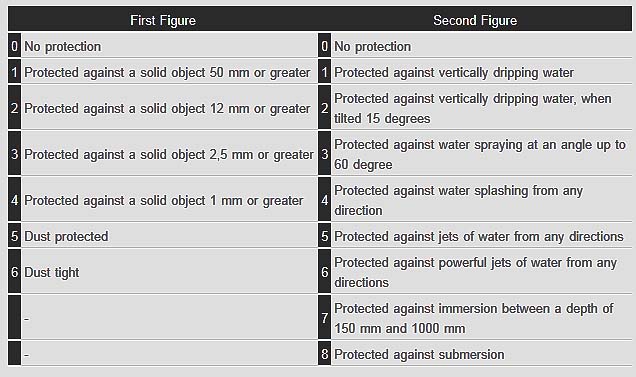
Correlations between IP (IEC) and NEMA 250 standards
IP10 -> NEMA 1
IP11 -> NEMA 2
IP54 -> NEMA 3 R
IP52 -> NEMA 5-12-12 K
IP54 -> NEMA 3-3 S
IP56 -> NEMA 4-4 X
IP67 -> NEMA 6-6 P[ http://electrical-engineering-portal.com/ip-protection-degree-iec-60529-explained]
Тематики
- безопасность машин и труда в целом
- электробезопасность
- электротехника, основные понятия
Действия
- степень защиты
- степень защиты, обеспечиваемая оболочкой
- степень защиты, обеспечиваемая оболочкой (код IP)
EN
- amount of protection
- degree of protection IP
- degree of protection of an enclosure
- degree of protection of enclosure
- degree of protection provided by enclosure
- enclosure rating
- ingress protection rating
- IP
- IP degree of protection,
- IP rating
- IP Sealing Specification
- IP security
- IPSec
- level of protection
- mechanical rating
- protection
- protection index
- protection rating
DE
- IP-Schutzgrad, m
- Schutzart des Gehäuses, f
FR
3.1.12 Интернет протокол (Internet Protocol; IP): Межсетевой протокол пакетной передачи, работает с 32 битовыми адресами, обеспечивает адресацию и маршрутизацию пакетов в сети; работает без установления соединения, не обеспечивает сохранение порядка следования пакетов, не гарантирует доставку пакетов.
Источник: ГОСТ Р 53531-2009: Телевидение вещательное цифровое. Требования к защите информации от несанкционированного доступа в сетях кабельного и наземного телевизионного вещания. Основные параметры. Технические требования оригинал документа
Англо-русский словарь нормативно-технической терминологии > Ip
-
14 address
əˈdres
1. сущ.
1) адрес at an address ≈ по адресу At what address does she live? ≈ По какому адресу она живет? Какой у нее адрес? accommodation address ≈ адрес до востребования;
"почтовый ящик" (тип адреса) business address ≈ рабочий адрес, адрес организации forwarding address ≈ адрес, по которому следует пересылать письма home address ≈ домашний адрес permanent address ≈ постоянное место жительства return address ≈ обратный адрес temporary address ≈ временное место жительства
2) обращение;
речь;
выступление an address about (concerning) smth. ≈ выступление, касающееся тех или иных проблем to deliver, give an address ≈ выступить с речью He had scheduled an address to the American people for the evening of May
27. ≈ Он планировал выступить с обращением к американским гражданам вечером 27 мая. eloquent address inaugural address keynote address moving address stirring address Syn: speech
3) такт;
ловкость;
(умелое) обхождение
4) мн. ухаживание to pay one's addresses to a lady ≈ ухаживать за дамой The black footman persecuted her with his addresses. ≈ Чернокожий лакей докучал ей своими ухаживаниями.
2. гл.
1) адресовать;
направлять (to ≈ кому-л.) I addressed the letter to him. ≈ Я направил ему письмо. How shall I address this parcel? ≈ Какой адрес мне написать на этой посылке? You must address your complaints to Head Office. ≈ Вы должны направить ваши жалобы начальству. ship to be addressed to Marseille ≈ корабль, направляющийся в Марсель Syn: direct
2)
2) обращаться к кому-л., адресоваться;
выступать to address a meeting ≈ выступать с речью на собрании to address oneself to the audience ≈ обращаться к аудитории She addressed her remarks to us. ≈ Она адресовала свои замечания нам. He addressed the speaker with a question. ≈ Он обратился к докладчику с вопросом. He will address us on modern art. ≈ Он сделает нам доклад о современном искусстве. to address oneself to all the people in the world ≈ взывать ко всем народам мира to address oneself to one's common sense ≈ обращаться к здравому смыслу to address smb. by his surname ≈ обращаться к кому-л. по фамилии You should address him as 'sir'. ≈ При обращении вы должны называть его "сэр". In speaking an ambassador is usually addressed as "Your Excellency". ≈ При разговоре посла обычно называют "ваше превосходительство".
3) возвр.;
книж. направлять силы/энергию на что-л.;
браться за что-л. (to) to address oneself to the business of doing smth. ≈ приниматься за какое-л. дело to address oneself to smth. ≈ приниматься за что-л. I addressed myself to learning Spanish. ≈ Я принялся за изучение испанского.адрес;
- to change one's * переехать выступление;
речь;
обращение;
адрес;
- opening * вступительное слово;
- formal * официальное выступление;
- * on current problems доклад о текущих вопросах;
- to give an * произнести речь официальная форма обращения к кому-л.;
- what is the correct form of * to a life peer? как следует обращаться к пожизненному пэру? (устаревшее) манера говорить;
- man of rude * грубиян, неотесанный человек( устаревшее) ловкость, искусство, такт;
- a man of awkward * человек, не обладающий ловкостью;
- to show great * проявлять величайший такт;
- to handle a matter with * искусно справиться с каким-л. делом ухаживание;
- to pay one's *es to a lady ухаживать за дамой (компьютерное) адрес;
- * space адресное пространство адресовать;
направлять;
- to * a letter to smb. направить письмо кому-л.;
- he *ed me to his chief он направил меня к своему начальнику;
- to * a ship адресовать судно;
- to * a warning to smb. послать кому-л. предупреждение написать адрес обращаться к кому-л.;
- were your words *ed to me or to him? вы говорите мне или ему?;
- he *ed himself to the chairman он обратился к председателю выступать;
- to * a meeting выступать с речью на собрании;
обратиться к собравшимся выбирать форму обращения к кому-л.;
обращаться, адресоваться;
- how does one * the governor? как следует обращаться к губернатору?;
- you * a woman chairman as Madam Chairwoman обращаясь к председателю-женщине, вы называете ее госпожа председатель (to) направлять силы или энергию на что-л.;
браться за что-л.;
- to * oneself to smth. приниматься за что-л.;
- to * oneself to the business of doing smth. приниматься за какое-л. дело;
- he *ed himself to the main difficulty он постарался справиться с главной трудностью;
- there are two questions of which I will * myself in this lecture в своей лекции я остановлюсь на двух вопросах (устаревшее) ухаживать, обхаживать, добиваться руки девушки (компьютерное) указывать адрес хранения информацииabsolute ~ вчт. абсолютный адресaccommodation ~ адрес до востребования accommodation ~ адрес на абонементный ящик accommodation ~ адрес приема корреспонденцииactual ~ вчт. абсолютный адрес actual ~ вчт. действительный адрес actual ~ вчт. исполнительный адресaddress вчт. адрес ~ адрес ~ адрес;
адресовать ~ вчт. адресовать ~ адресовать;
направлять ~ адресовать ~ выступать ~ выступление ~ направлять ~ обращаться (к кому-л.) ;
выступать;
to address a meeting выступать с речью на собрании;
to address oneself to the audience обращаться к аудитории ~ обращаться ~ обращение;
речь;
выступление ~ обращение ~ обращение;
обращаться Address: Address парл. речь главы государства ~ речь при открытии сессии парламента address: address такт;
ловкость;
(умелое) обхождение ~ pl ухаживание;
to pay one's addresses to a lady ухаживать за дамой ~ часть искового заявления, содержащая наименование суда, в который подается иск ~ часть искового заявления~ обращаться (к кому-л.) ;
выступать;
to address a meeting выступать с речью на собрании;
to address oneself to the audience обращаться к аудитории~ a request to обращаться с просьбойto ~ oneself (to smth.) браться, приниматься (за что-л.)~ обращаться (к кому-л.) ;
выступать;
to address a meeting выступать с речью на собрании;
to address oneself to the audience обращаться к аудиторииarea ~ вчт. адрес областиasterisk ~ вчт. звездочный адресbase ~ вчт. базовый адресbased ~ вчт. базируемый адресbusiness ~ служебный адресcall ~ вчт. адрес вызова call ~ вчт. адрес обращенияcurrent ~ вчт. текущий адресdata ~ вчт. адрес данныхdeferred ~ вчт. косвенный адресdestination ~ вчт. адрес назначенияdirect ~ вчт. прямой адресeffective ~ вчт. исполнительный адресerror ~ вчт. адрес ошибкиfast ~ вчт. фиксированный адресfirst-level ~ вчт. прямой адресframe ~ вчт. опорный адресgenerated ~ вчт. сформированный адресglobal ~ вчт. глобальный адресhash ~ вчт. хешированный адресhigh load ~ вчт. старший адрес загрузкиhigher ~ вчт. более старший адресhome ~ домашний адрес home ~ вчт. собственный адресimmediate ~ вчт. непосредственный операндimplied ~ вчт. неявный адресinaugural ~ речь при вступлении в должность inaugural ~ речь при открытииindexed ~ вчт. индексированный адресindirect ~ вчт. косвенный адресinitial ~ вчт. начальный адресinstruction ~ вчт. адрес командinternal ~ вчт. внутренний адресjump ~ вчт. адрес переходаlinkage ~ вчт. адрес связейlistener ~ вчт. адрес получателяload ~ вчт. загрузочный адресlower ~ вчт. более младший адресmachine ~ вчт. машинный адресmulticast ~ вчт. групповой адресmultilevel ~ вчт. многоуровневый адресnetwork ~ вчт. сетевой адресone-level ~ вчт. прямой адресopening ~ первый адресout-of-range ~ вчт. адрес за адресным пространством~ pl ухаживание;
to pay one's addresses to a lady ухаживать за дамойphysical ~ вчт. физический адресpointer ~ вчт. адрес-указательpostal ~ почтовый адресpresumptive ~ вчт. исходный адресrecord ~ вчт. адрес записиrelative ~ вчт. относительный адресresidential ~ адрес места жительстваrestart ~ вчт. адрес рестартаresult ~ вчт. адрес результатаsecond-level ~ вчт. косвенный адресsingle-level ~ вчт. прямой адресsource ~ вчт. адрес источника данныхstop ~ вчт. адрес остановаsymbolic ~ вчт. символический адресtalk ~ вчт. адрес отправителяtalker ~ вчт. адрес отправителяthird-level ~ вчт. дважды косвенный адресtrack ~ вчт. адрес дорожкиtrue ~ вчт. истинный адресtwo-level ~ вчт. косвенный адресunit ~ вчт. адрес устройстваunload ~ вчт. адрес разгрузкиvariable ~ вчт. адрес переменнойvirtual ~ вчт. виртуальный адресzero-level ~ вчт. непосредственный операнд -
15 chart
1. диаграмма; схема; чертёж; таблица; график; карта || наносить на карту; чертить диаграмму, схему, чертёж или карту2. лента ( или бумага) для самопишущего прибора— recording chart
* * *
2. диаграмма; схема; таблица; план; график; чертёж
* * *
диаграмма, карта, таблица, палетка, график; схема; диаграммная бумага регистрирующего аппарата
* * *
1) диаграмма; схема; таблица; расчётная номограмма; план; график; чертёж•- automated control chart
- bathtub chart
- calibration chart
- capillarity-correction chart
- casing design chart
- cause-consequence chart
- control chart
- correction chart
- correction chart for mud cake
- cumulative production chart
- direct-dip-reading chart
- direct-reading capillarity chart
- empirical chart
- equipment status chart
- failure chart
- flow chart
- follower chart
- gas-oil ratio chart
- induction log correction chart
- initial production chart
- invaded-zone correction chart
- isochron chart
- layout chart
- life cycle chart
- log correction chart
- maintenance chart
- maintenance allocation chart
- maintenance dependency chart
- MAPI chart
- outage control chart
- overlay chart
- prediction chart
- process flow chart
- progress chart
- refinery calculation chart
- reliability level chart
- reliability organization chart
- reliability sequential chart
- salty mud chart
- sequential test chart
- service chart
- shoulder-bed chart
- stacking chart
- tank volume chart
- temperature-distillation chart
- test correction chart
- test flow chart
- test performance chart
- time-depth chart
- trouble chart
- trouble-shooting chart
- tube-life chart
- viscosity-gravity chart
- wavefront chart
- weathering chart
- well spacing chart* * * -
16 address
[əˈdres]absolute address вчт. абсолютный адрес accommodation address адрес до востребования accommodation address адрес на абонементный ящик accommodation address адрес приема корреспонденции actual address вчт. абсолютный адрес actual address вчт. действительный адрес actual address вчт. исполнительный адрес address вчт. адрес address адрес address адрес; адресовать address вчт. адресовать address адресовать; направлять address адресовать address выступать address выступление address направлять address обращаться (к кому-л.); выступать; to address a meeting выступать с речью на собрании; to address oneself to the audience обращаться к аудитории address обращаться address обращение; речь; выступление address обращение address обращение; обращаться Address: Address парл. речь главы государства address речь при открытии сессии парламента address: address такт; ловкость; (умелое) обхождение address pl ухаживание; to pay one's addresses to a lady ухаживать за дамой address часть искового заявления, содержащая наименование суда, в который подается иск address часть искового заявления address обращаться (к кому-л.); выступать; to address a meeting выступать с речью на собрании; to address oneself to the audience обращаться к аудитории address a request to обращаться с просьбой address for service наименование суда для подачи искового заявления to address oneself (to smth.) браться, приниматься (за что-л.) address обращаться (к кому-л.); выступать; to address a meeting выступать с речью на собрании; to address oneself to the audience обращаться к аудитории area address вчт. адрес области asterisk address вчт. звездочный адрес base address вчт. базовый адрес based address вчт. базируемый адрес bottom address вчт. нижний адрес business address служебный адрес cable address адрес для телеграмм cable address телеграфный адрес call address вчт. адрес вызова call address вчт. адрес обращения change one's address изменять свой адрес current address вчт. текущий адрес data address вчт. адрес данных deferred address вчт. косвенный адрес destination address вчт. адрес назначения direct address вчт. прямой адрес dummy address вчт. псевдоадрес dummy address вчт. фиктивный адрес effective address вчт. исполнительный адрес entry point address вчт. адрес точки входа error address вчт. адрес ошибки external address вчт. внешний адрес fast address вчт. фиксированный адрес first-level address вчт. прямой адрес frame address вчт. опорный адрес generated address вчт. сформированный адрес global address вчт. глобальный адрес hash address вчт. хешированный адрес high load address вчт. старший адрес загрузки higher address вчт. более старший адрес home address домашний адрес home address вчт. собственный адрес immediate address вчт. непосредственный операнд implied address вчт. неявный адрес inaugural address речь при вступлении в должность inaugural address речь при открытии indexed address вчт. индексированный адрес indirect address вчт. косвенный адрес initial address вчт. начальный адрес instruction address вчт. адрес команд internal address вчт. внутренний адрес jump address вчт. адрес перехода linkage address вчт. адрес связей listener address вчт. адрес получателя load address вчт. загрузочный адрес lower address вчт. более младший адрес machine address вчт. машинный адрес mailing address почтовый адрес multicast address вчт. групповой адрес multilevel address вчт. многоуровневый адрес network address вчт. сетевой адрес one-level address вчт. прямой адрес opening address первый адрес out-of-range address вчт. адрес за адресным пространством address pl ухаживание; to pay one's addresses to a lady ухаживать за дамой permanent address постоянный адрес physical address вчт. физический адрес pointer address вчт. адрес-указатель postal address почтовый адрес presumptive address вчт. исходный адрес private address личный адрес record address вчт. адрес записи reference address вчт. адрес ссылки reference address вчт. базовый адрес registered address зарегистрированный адрес relative address вчт. относительный адрес relocatable address вчт. настраиваемый адрес relocatable address вчт. перемещаемый адрес residential address адрес места жительства restart address вчт. адрес рестарта result address вчт. адрес результата return address вчт. адрес возврата return address обратный адрес second-level address вчт. косвенный адрес single-level address вчт. прямой адрес source address вчт. адрес источника данных stop address вчт. адрес останова symbolic address вчт. символический адрес talk address вчт. адрес отправителя talker address вчт. адрес отправителя temporary address временный адрес third-level address вчт. дважды косвенный адрес track address вчт. адрес дорожки true address вчт. истинный адрес two-level address вчт. косвенный адрес unit address вчт. адрес устройства unload address вчт. адрес разгрузки variable address вчт. адрес переменной virtual address вчт. виртуальный адрес zero-level address вчт. непосредственный операнд -
17 voltage
1) напряжение, разность потенциалов2) потенциал3) электродвижущая сила, эдс•voltage across smth — напряжение на чем-л.;voltage applied to smth — напряжение, приложенное к чему-л.;voltage between phases — междуфазное [линейное\] напряжение;voltage to earth [to ground\] — напряжение относительно земли;to handle voltage — выдерживать напряжение;-
ac voltage
-
accelerating voltage
-
active component voltage
-
active voltage
-
actuating voltage
-
adjusting voltage
-
aging voltage
-
allowable voltage
-
alternating voltage
-
alternator field voltage
-
anode voltage
-
applied voltage
-
arc voltage
-
arc-drop voltage
-
arcing voltage
-
arc-stream voltage
-
average voltage
-
back voltage
-
background ionization voltage
-
backward voltage
-
balanced voltage
-
balancing voltage
-
bandgap voltage
-
barrier voltage
-
bar-to-bar voltage
-
base voltage
-
battery voltage
-
bias voltage
-
bidirectional voltage
-
black-out voltage
-
blanking voltage
-
blocking voltage
-
branch voltage
-
breakdown voltage
-
breakover voltage
-
bridge supply voltage
-
bucking voltage
-
built-in voltage
-
burning voltage
-
burnout voltage
-
bus voltage
-
calibration voltage
-
capacitor voltage
-
carrier voltage
-
category voltage
-
catenary voltage
-
cathode voltage
-
ceiling voltage
-
cell voltage
-
charge voltage
-
circuit voltage
-
clamp voltage
-
clock voltage
-
closed-circuit voltage
-
commercial-frequency voltage
-
commercial-frequency withstand voltage
-
common-mode voltage
-
commutating voltage
-
commutator voltage
-
compensating voltage
-
complex voltage
-
component voltage
-
constant voltage
-
contact voltage
-
control voltage
-
convergence voltage
-
corona voltage
-
corona-onset voltage
-
counter voltage
-
crest voltage
-
critical corona voltage
-
critical visual corona voltage
-
critical voltage
-
current-noise voltage
-
current-resistance voltage
-
cutoff voltage
-
cycling voltage
-
dc recovery voltage
-
dc voltage
-
decelerating voltage
-
decomposition voltage
-
deflecting voltage
-
delta voltage
-
design voltage
-
dielectric breakdown voltage
-
direct voltage
-
direct-axis component voltage behind transient reactance
-
direct-axis subtransient internal voltage
-
direct-axis subtransient voltage
-
direct-axis synchronous internal voltage
-
direct-axis synchronous voltage
-
direct-axis transient internal voltage
-
direct-axis transient voltage
-
discharge extinction voltage
-
discharge inception voltage
-
discharge ionization voltage
-
discharge voltage
-
disruptive discharge voltage
-
disruptive voltage
-
dissymmetrical voltage
-
disturbance voltage
-
driving voltage
-
drop-away voltage
-
dry withstand voltage
-
effective voltage
-
electric cell voltage
-
electrode voltage
-
end voltage
-
end-point voltage
-
equilibrium voltage
-
equivalent input noise voltage
-
error voltage
-
excess voltage
-
excitation voltage
-
exciter voltage
-
extinction voltage
-
extinguishing voltage
-
extrahigh voltage
-
Faraday voltage
-
fatal voltage
-
feedback voltage
-
field voltage
-
filament voltage
-
final acceleration voltage
-
final voltage
-
fire-back voltage
-
firing voltage
-
flash test voltage
-
flashover voltage
-
floating voltage
-
flyback voltage
-
focusing voltage
-
focus voltage
-
formation voltage
-
forward voltage
-
gas-discharge maintaining voltage
-
gate nontrigger voltage
-
gate trigger voltage
-
gate turn-off voltage
-
gate voltage
-
gating voltage
-
generated voltage
-
generator voltage
-
glow-discharge sustaining voltage
-
grid driving voltage
-
ground voltage
-
Hall voltage
-
heater voltage
-
high voltage
-
high-level voltage
-
ignition voltage
-
impedance voltage
-
impressed voltage
-
impulse testing voltage
-
impulse voltage
-
impulse withstand voltage
-
induced body voltage
-
induced voltage
-
inductance voltage
-
initial ionization voltage
-
initial voltage
-
injected voltage
-
in-phase voltage
-
input voltage
-
instantaneous voltage
-
interference voltage
-
internal voltage
-
inverse voltage
-
ionizing voltage
-
junction voltage
-
keep-alive voltage
-
lagging voltage
-
leading voltage
-
leakage reactance voltage
-
leakage voltage
-
lightning impulse flashover voltage
-
lightning impulse voltage
-
lightning impulse withstanding voltage
-
lightning induced voltage
-
limit voltage
-
limiting voltage
-
line voltage
-
linearity trim voltage
-
line-to-earth voltage
-
line-to-line voltage
-
loading voltage
-
load voltage
-
locked rotor voltage
-
locking voltage
-
logic threshold voltage
-
low voltage
-
low-level voltage
-
mains voltage
-
maintaining voltage
-
maximum operating voltage
-
maximum-power-point voltage
-
medium voltage
-
modulation voltage
-
negative phase-sequence voltage
-
negative sequence voltage
-
net voltage
-
neutral-to-ground voltage
-
nodal voltage
-
noise voltage
-
no-load field voltage
-
no-load voltage
-
nominal excitation ceiling voltage
-
nominal voltage
-
normal voltage
-
off-load voltage
-
offset voltage
-
off-standard voltage
-
off-state voltage
-
one-minute test voltage
-
one-minute withstand voltage
-
on-load voltage
-
on-state voltage
-
open-circuit secondary voltage
-
open-circuit voltage
-
operate voltage
-
operating supply voltage
-
operating voltage
-
out-of-phase voltage
-
output voltage
-
pace voltage
-
partial discharge extinction voltage
-
partial discharge inception voltage
-
peak arc voltage
-
peak reverse voltage
-
peak voltage
-
peak-point voltage
-
peak-to-peak ripple voltage
-
peak-to-peak voltage
-
per unit voltage
-
periodic voltage
-
permissible voltage
-
phase voltage
-
phase-to-ground voltage
-
phase-to-phase voltage
-
pickup voltage
-
pinch-off voltage
-
plate voltage
-
polarization voltage
-
positive-phase-sequence voltage
-
positive-sequence voltage
-
power-frequency voltage
-
preset voltage
-
presparkover voltage
-
primary voltage
-
probe voltage
-
protection voltage
-
psophometric voltage
-
pull-in voltage
-
pull-out voltage
-
pulsating voltage
-
pulse breakdown voltage
-
pulse noise voltage
-
punch-through voltage
-
puncture voltage
-
quadrature-axis component voltage behind transient reactance
-
quadrature-axis subtransient internal voltage
-
quadrature-axis subtransient voltage
-
quadrature-axis synchronous internal voltage
-
quadrature-axis synchronous voltage
-
quadrature-axis transient internal voltage
-
quadrature-axis transient voltage
-
quiescent input voltage
-
quiescent output voltage
-
radio interference voltage
-
rated impulse withstand voltage
-
rated temperature-rise voltage
-
rated voltage
-
reach-through voltage
-
reactance voltage
-
receiver voltage
-
receiving-end voltage
-
recovery voltage
-
rectified voltage
-
reduced voltage
-
reference voltage
-
reignition voltage
-
release voltage
-
repetitive voltage
-
residual voltage
-
resistance voltage
-
resonance voltage
-
response voltage
-
restoring voltage
-
restraining voltage
-
restriking voltage
-
reverse voltage
-
ring voltage
-
ring-to-ring voltage
-
ripple voltage
-
root-mean-square voltage
-
running voltage
-
safety extralow voltage
-
saturation voltage
-
sawtooth voltage
-
secondary voltage
-
self-induction voltage
-
sending-end voltage
-
sense voltage
-
service voltage
-
shift voltage
-
shock voltage
-
short-circuit voltage
-
shorting voltage
-
shot-noise voltage
-
signal voltage
-
sine-curve voltage
-
sine voltage
-
sine-wave voltage
-
sinusoidal voltage
-
slip-ring voltage
-
smoothed dc voltage
-
source voltage
-
spark-gap breakdown voltage
-
sparking voltage
-
sparkover voltage
-
speed-induced voltage
-
speed voltage
-
spot cutoff voltage
-
square-wave voltage
-
stabilized voltage
-
standard voltage
-
star voltage
-
starting voltage
-
static breakdown voltage
-
station auxiliaries voltage
-
steady-state voltage
-
step voltage
-
stray voltage
-
striking voltage
-
subtransient internal voltage
-
subtransient voltage
-
superimposed voltage
-
supply voltage
-
supply-line voltage
-
surge voltage
-
sustaining voltage
-
sweep voltage
-
swing voltage
-
switching surge voltage
-
switching voltage
-
symmetrical voltage
-
synchronous generator internal voltage
-
synchronous generator voltage
-
system voltage
-
tank voltage
-
tapping voltage
-
temperature voltage
-
terminal voltage
-
testing voltage
-
test voltage
-
thermal noise voltage
-
thermocouple voltage
-
thermoelectric voltage
-
threshold voltage
-
tooth voltage
-
touch voltage
-
transient internal voltage
-
transient recovery voltage
-
transient voltage
-
transmission-line voltage
-
trigger voltage
-
tuning voltage
-
turnoff voltage
-
ultor voltage
-
ultrahigh voltage
-
unbalanced voltage
-
unidirectional voltage
-
upper voltage
-
variable voltage
-
welding voltage
-
welding-arc voltage
-
wet switching surge withstand voltage
-
wet withstand voltage
-
withstanding voltage
-
withstand voltage
-
working voltage
-
Y-voltage
-
zener voltage
-
zero-phase-sequence voltage
-
zero-sequence voltage -
18 approach
approach nзаход на посадкуabbreviated visual approachвизуальный заход на посадку по упрощенной схемеadvisory approachзаход на посадку по командам наземных станцийaerodrome approachподход к зоне аэродромаaerodrome approach aidsаэродромные средства захода на посадкуaerodrome approach areaзона подхода к аэродромуaerodrome approach chartкарта подходов к аэродромуaerodrome approach control systemсистема управления подходом к аэродромуaerodrome approach lightsаэродромные огни приближенияaerodrome approach roadподъездная дорога к аэродромуaeronautical approach chartаэронавигационная карта воздушных подходовaids to approachсредства захода на посадкуangle of approachугол захода на посадкуangle of approach lightугол набора высотыapproach angle correctionкоррекция угла захода на посадкуapproach angle indicatorуказатель угла захода на посадкуapproach areaзона захода на посадкуapproach area hazardпрепятствие в зоне захода на посадкуapproach azimuthазимут захода на посадкуapproach azimuth antennaазимутальная антенна захода на посадкуapproach azimuth guidanceнаведение по азимуту при заходе на посадкуapproach beaconпосадочный маякapproach beamлуч захода на посадкуapproach ceilingвысота траектории начала захода на посадкуapproach chartсхема захода на посадкуapproach clearanceразрешение на заход на посадкуapproach computerвычислитель параметров захода на посадкуapproach controlуправление в зоне захода на посадкуapproach controllerдиспетчер захода на посадкуapproach control pointдиспетчерский пункт захода на посадкуapproach control radarрадиолокатор управления заходом на посадкуapproach control serviceдиспетчерская служба захода на посадкуapproach control towerпункт управления заходом на посадкуapproach control unitдиспетчерский пункт управления заходом на посадкуapproach courseкурс захода на посадкуapproach elevation antennaугломестная антенна захода на посадкуapproach endконец этапа захода на посадкуapproach facilitiesоборудование для обеспечения захода на посадкуapproach finalконечная прямая захода на посадкуapproach fixконтрольная точка захода на посадкуapproach flight reference pointконтрольная точка траектории захода на посадкуapproach flight track distanceдистанция при заходе на посадкуapproach flowнабегающий потокapproach funnelполоса воздушных подходовapproach glideпланирование при заходе на посадкуapproach glide slopeглиссада захода на посадкуapproach guidance nose-in to stand systemсистема управления воздушным судном при установке на стоянкуapproach headingкурс захода на посадкуapproach heightвысота при заходе на посадкуapproach idleрежим малого газа при заходе на посадкуapproach informationинформация о заходе на посадкуapproaching aircraftвоздушное судно, совершающее заход на посадкуapproach landingзаход на посадкуapproach legучасток захода на посадкуapproach light beaconпосадочный светомаякapproach lightingсистема посадочных огнейapproach lighting systemсистема огней подхода(к ВПП) approach lightsогни приближенияapproach lights collisionстолкновение с огнями приближенияapproach mass correctionпоправка на массу при заходе на посадкуapproach measurement distanceрасстояние до точки измерения при заходе на посадкуapproach navigationнавигация в зоне подходаapproach noise angleугол распространения шума при заходе на посадкуapproach noise levelуровень шума при заходе на посадкуapproach noise measurementизмерение шума при заходе на посадкуapproach noise pathтраектория распространения шумаapproach noise reference pointконтрольная точка замера шумов на участке захода на посадкуapproach operationзаход на посадкуapproach pathтраектория захода на посадкуapproach patternсхема захода на посадкуapproach phaseэтап захода на посадкуapproach procedureсхема захода на посадкуapproach profileпрофиль захода на посадкуapproach radar systemрадиолокационная система захода на посадкуapproach rate of descentскорость снижения при заходе на посадкуapproach sectorсектор подхода к аэродромуapproach segmentучасток захода на посадкуapproach sequenceочередность захода на посадкуapproach settingустановка в положение для захода на посадкуapproach slope guidanceнаведение по глиссаде при заходе на посадкуapproach slope indicatorиндикатор глиссады захода на посадкуapproach speedскорость захода на посадкуapproach systemсистема захода на посадкуapproach techniqueспособ захода на посадкуapproach terrainтерритория зоны захода на посадкуapproach test procedureметодика испытаний при заходе на посадкуapproach the beamприближаться к лучуapproach threshold lightsвходные огни ВППapproach timeвремя захода на посадкуapproach to land proceduresправила захода на посадкуapproach with flaps downзаход на посадку с выпущенными закрылкамиapproach zoneзона подхода к ВППautomatic approachавтоматический заход на посадкуautomatic approach systemсистема автоматического захода на посадкуazimuth approach pathтраектория захода на посадку по азимутуback course approachзаход на посадку с обратным курсомbeam approachзаход на посадку по маякуbeam approach beacon systemсистема посадки по лучу маякаblind approachзаход на посадку под шторкамиcenter line approachзаход на посадку по осевой линииcircling approachзаход на посадку по кругуcircling approach areaзона захода на посадку по кругуclearance for straight-in approachразрешение на заход на посадку с прямойcomplete approachвыполнять заход на посадкуcontact approachвизуальный заход на посадкуcontinuous descent approachзаход на посадку с непрерывным снижениемcoupled approachзаход на посадку с использованием бортовых и наземных средствcrossbar approach lighting systemсистема световых горизонтов огней подхода(к ВПП) crosswind approachзаход на посадку при боковом ветреcurved approachзаход на посадку по криволинейной траекторииdecelerating approachзаход на посадку с уменьшением скоростиdirection of approachнаправление захода на посадкуdiscontinue approachпрерывать заход на посадкуdiscontinued approachпрерванный заход на посадкуdiscontinued approach climbнабор высоты после прерванного захода на посадкуenter the final approach trackвыходить на посадочную прямуюexecute approachвыполнять заход на посадкуexpected approach timeпредполагаемое время захода на посадкуfinal approachконечный этап захода на посадкуfinal approach altitudeвысота разворота на посадочную прямуюfinal approach fixконтрольная точка конечного этапа захода на посадкуfinal approach operationполет на конечном этапе захода на посадкуfinal approach pathтраектория конечного этапа захода на посадкуfinal approach trackпосадочная прямаяflap approach positionположение закрылков при заходе на посадкуflat approachзаход на посадку по пологой траекторииfront course approachзаход на посадку по прямому курсуgliding approachзаход на посадку в режиме планированияground controlled approachзаход на посадку на посадку под контролем наземных средствground-controlled approach procedureсхема захода на посадку по командам с землиhead-on approachсближение на встречных курсахhelicopter approach heightвысота полета вертолета при заходе на посадкуinitial approachначальный этап захода на посадкуinitial approach altitudeвысота начального этапа захода на посадкуinitial approach fixконтрольная точка начального этапа захода на посадкуinitial approach segmentначальный участок захода на посадкуinner approach lightingсветосигнальное оборудование ближней зоны приближенияinstrument approach chartсхема захода на посадку по приборамinstrument approach courseкурс захода на посадку по приборамinstrument approach landingзаход на посадку по приборамinstrument approach procedureсхема захода на посадку по приборамinstrument landing approachзаход на посадку по приборамintermediate approachпромежуточный этап захода на посадкуintermediate approach fixконтрольная точка промежуточного этапа захода на посадкуintermediate approach operationвыполнение промежуточного этапа захода на посадкуland approachзаход на посадкуlanding approach speedскорость захода на посадкуleft-hand approachзаход на посадку с левым разворотомlocalizer approachзаход на посадку по курсовому маякуlocalizer approach trackтраектория захода на посадку по лучу курсового маякаlong approachзаход на посадку по полной схемеlow-visibility approachзаход на посадку в условиях ограниченной видимостиmeasured approach profileразбитый на участки профиль захода на посадкуmiss approachуходить на второй кругmissed approachуход на второй кругmissed approach azimuthазимут ухода на второй кругmissed approach operationуход на второй круг с этапа захода на посадкуmissed approach procedureсхема ухода на второй кругmissed approach procedure trackмаршрут ухода на второй кругno-aids used approachзаход на посадку без использования навигационных средствno-flap approach speedскорость захода на посадку с убранными закрылкамиno-flap - no-slat approach speedскорость захода на посадку с убранной механизацией крылаnoise certification approach pathтраектория захода на посадку, сертифицированная по шумуnominal approach pathноминальная траектория захода на посадкуnonprecision approachзаход на посадку без использования средств точного заходаnonprecision approach procedureсхема захода на посадку без применения радиолокационных средствnonprecision approach runwayВПП, не оборудованная для точного захода на посадкуnonstraight-in approachзаход на посадку не с прямойnormal approachзаход на посадку по обычной схемеno-slat approach speedскорость захода на посадку с убранными предкрылкамиoffset approachзаход на посадку под угломone-eighty approachзаход на посадку с обратным курсомpractice low approachтренировочный заход на посадкуprecision approachточный заход на посадкуprecision approach lighting systemсистема огней точного захода на посадкуprecision approach pathтраектория точного захода на посадкуprecision approach path indicatorуказатель траектории точного захода на посадкуprecision approach procedureсхема точного захода на посадкуprecision approach radarрадиолокатор точного захода на посадкуprecision approach radar systemрадиолокационная система точного захода на посадкуprecision approach runwayВПП, оборудованная для точного захода на посадкуprecision approach terrain chartкарта местности зоны точного захода на посадкуprocedure approach trackмаршрут захода на посадкуradar approachзаход на посадку по радиолокаторуradar approach beaconрадиолокационный маякradar approach controlцентр радиолокационного управления заходом на посадкуradio approach aidsрадиосредства захода на посадкуrectangular approach traffic patternсхема захода на посадку по коробочкеrectangular traffic pattern approachзаход на посадку по коробочкеreference approach angleисходный угол захода на посадкуreference approach heightисходная высота полета при заходе на посадкуright-hand approachзаход на посадку с правым разворотомrunway approach surveillance radarобзорный радиолокатор подхода к ВППsegmented approachзаход на посадку по сегментно-криволинейной схемеsegmented approach pathсегментная траектория захода на посадкуselected approach altitudeвыбранная высота захода на посадкуselected approach slopeвыбранный наклон глиссады захода на посадкуserve approachобеспечивать заход на посадкуshort approachзаход на посадку по укороченной схемеsimple approachзаход на посадку по упрощенной схемеsimple approach lighting systemупрощенная система огней подхода(к ВПП) standard approachстандартный заход на посадкуstandard approach systemстандартная система захода на посадкуstandard beam approach systemстандартная система управления заходом на посадку по лучуsteadiness of approachустойчивость при заходе на посадкуsteady approachзаход на посадку на установившемся режимеsteep approachзаход на посадку по крутой траекторииstep-down approachступенчатый заход на посадкуstraight-in approachзаход на посадку с прямойstraight-in approach pathтраектория захода на посадку с прямойstraight-in ILS-type approachзаход на посадку с прямой по приборамsurveillance radar approachзаход на посадку по обзорному радиолокаторуsymmetric thrust approachзаход на посадку при симметричной тягеteardrop approachзаход на посадку с отворотом на расчетный уголtimed approachзаход на посадку, нормированный по времениupwind approachзаход на посадку против ветраvisual aids to approachвизуальные средства захода на посадкуvisual approachвизуальный заход на посадкуvisual approach indicatorвизуальный указатель глиссадыvisual approach slope indicator systemсистема визуальной индикации глиссадыvisual approach streamlineсхема визуального захода на посадку -
19 charge
tʃɑ:dʒ
1. сущ.
1) а) заряд charge of gunpowder ≈ пороховой заряд positive (negative) charge ≈ положительный (отрицательный) заряд б) амер. одна доза, инъекция наркотика;
марихуана, особ. сигарета с марихуаной в) сл. заряд (имеющаяся или скопившаяся в человеке, художественном произведении и т. п. энергия) the deeply emotional charge of the drama ≈ огромный эмоциональный заряд драмы г) амер.;
сл. возбуждение, приятное волнение He got a charge out of the game. ≈ Он почувствовал приятное возбуждение от игры. He was getting a charge out of being close to something big. ≈ Он испытывал приятное волнение, находясь рядом с чем-то большим. Syn: thrill, kick I
1.
2) допускаемая нагрузка, загрузка
3) геральдика любой девиз, символ, фигура на геральдическом щите
4) а) обязанности, ответственность;
руководство He has charge of the home office. ≈ Он отвечает за главный офис. This ward of the hospital is in/under the charge of Dr. Green. ≈ Эта палата находится в ведении доктора Грина. Syn: commission
1., trust
1. responsibility, obligation, management, supervision б) забота, попечение, надзор, наблюдение (когда речь идет о человеке или животном) ;
хранение (вещи) children in charge of a nurse ≈ дети под присмотром няни Mary was put in charge of the child. ≈ Мери поручили присматривать за ребенком. I hope you'll never become a charge on the public. ≈ Я надеюсь, что ты никогда не будешь просить милостыню. Syn: care
1., custody, superintendence ∙ place in charge of put in charge of - take charge of give in charge
5) а) подопечный young charges ≈ дети, находящиеся на попечении( у кого-л.) б) церк. паства
6) а) указание, предписание;
приказ;
наказ Syn: precept, injunction, instruction, mandate
1., order
1., command
1. б) юр. напутствие судьи присяжным в) церк. послание епископа к пастве
7) а) цена;
мн. расходы, издержки at his own charge ≈ на его собственный счет to make a charge ≈ сделать некоторые расходы to reverse( the) charges, to transfer( the) charges брит.≈ изменять цены exorbitant charge ≈ очень высокие цены reasonable charge ≈ разумная цена admission charge ≈ вступительный взнос service charge ≈ плата за обслуживание There will be no charge for installation. ≈ Установка будет осуществлена бесплатно. free of charge ≈ бесплатно, даром charges forward ≈ доставка за счет покупателя Syn: expense, cost
1. б) занесение на счет
8) налог
9) а) обвинение to bring, level, make a charge ≈ предъявить обвинение to bring charges of forgery against smb. ≈ обвинить кого-л. в подделывании денег to concoct, cook up, fabricate, trump up a charge ≈ фабриковать обвинение They trumped up various charges against her. ≈ Они сфабриковали против нее целый ворох обвинений. to prove, substantiate a charge ≈ доказать обвинение to face a charge ≈ быть обвиненным в чем-либо;
смело встречать обвинение to lay to smb.'s charge ≈ обвинять кого-л. to dismiss a charge, to throw out a charge ≈ отклонять обвинение, опровергать обвинение The judge dismissed all charges. ≈ Судья снял все обвинения. to drop, retract, withdraw a charge ≈ отказываться от обвинения to deny, refute, repudiate a charge ≈ отрицать обвинение baseless, fabricated, false, trumped-up charge ≈ лживое обвинение, сфабрикованное обвинение frivolous charge ≈ пустое, пустячное обвинение charge of murder ≈ обвинение в убийстве to be arrested on various charges ≈ быть арестованным на основании нескольких обвинений Syn: accusation б) (полиц. жаргон) обвиняемый One by one the 'charges' were brought in and set before him. ≈ Обвиняемых вводили одного за другим и ставили перед ним.
10) а) воен. (стремительная) атака, наступление to lead a charge against, to make a charge against ≈ идти в атаку против кого-л. to fight off a charge, to repel a charge, to repulse a charge ≈ отражать атаку, отражать нападение, давать отпор bayonet charge ≈ штыковая атака cavalry charge ≈ кавалерийская атака infantry charge ≈ наступление пехоты б) атака, нападение (о крупных животных, игроках, напр., в футболе и т. п.) в) сигнал атаки a trumpet charge ≈ сигнал трубы к наступлению to sound the charge ≈ возвестить о начале наступления, дать сигнал к наступлению
11) метал. шихта;
колоша ∙ return to the charge
2. гл.
1) заряжать (оружие;
аккумулятор) (with) The wire is charged with electricity. ≈ Этот провод под напряжением. The terrorists charged the bomb with an explosive substance. ≈ Террористы зарядили бомбу взрывчаткой. Syn: load
2.
2) а) нагружать;
загружать (уголь в топку и т. п.) б) насыщать, наполнять (напр., воду минеральными веществами, воздух парами и т. д.) в) заполнять, наполнять, пронизывать;
обременять The music is charged with excitement. ≈ Вся музыка проникнута трепетом. His poetry is charged with strength and feeling. ≈ Его поэзия блещет мощью и чувством. The stores of fact with which his memory was charged. ≈ Хранилище фактов, которыми была обременена его память.
3) геральдика помещать на щите какой-л. символ
4) поручать, давать поручение, возлагать( ответственность и т. п.) They chargeed him with the job of finding a new meeting place. ≈ Они поручили ему найти новое место для сборищ. to charge oneself with ≈ взять на себя заботу о чем-л., ответственность за что-л.
5) а) указывать, предписывать;
приказывать, требовать I charge you not to go. ≈ Я требую, чтобы вы остались. Syn: command
2., order
2., enjoin б) юр. напутствовать присяжных( о судье) в) наставлять паству (о епископе)
6) а) назначать, запрашивать цену They charged us ten dollars for it. ≈ Они взяли с нас за это десять долларов. What do you charge for it? ≈ Сколько вы просите за это? Сколько это стоит? How much does the hotel charge for a room? ≈ Сколько стоит номер в этом отеле? to charge on ≈ взимать б) записывать в долг;
записывать на чей-л. счет Charge the goods against/to my account. ≈ Запишите эти вещи на мой счет.
7) а) порицать, осуждать;
обвинять They charges him with armed robbery. ≈ Они обвиняют его в вооруженном ограблении. They were charged as being instigators. ≈ Им предъявили обвинение в подстрекательстве. Syn: blame
2., censure
2., accuse б) возлагать ответственность, приписывать charge her failure to negligence ≈ приписать неудачу ее халатности
8) а) изготавливать( оружие) к бою б) воен. атаковать( особ. в конном строю) в) нападать, атаковать, набрасываться;
напирать, наседать to charge at ≈ нападать на кого-л. You should have seen me run when that goat charged at me! ≈ Ты бы видел, как этот козел на меня побежал! to charge down ≈ кидаться к кому-л. When Mother returned from the hospital, the children charged down to meet her. ≈ Когда мама вернулась из больницы, дети ринулись ей навстречу. to charge into ≈ врываться ∙ Syn: attack
2. ∙ charge against charge down charge off charge with нагрузка, загрузка;
- * of surety( специальное) допускаемая нагрузка;
- additional * (специальное) догрузка;
- reactivity * (специальное) запас реактивности заряд - the emotional * of the drama эмоциональный заряд этой драмы сигарета с марихуаной приятное волнение, возбуждение;
наслаждение, удовольствие;
- to get a * out of smth. получать удовольствие от чего-л запись о выдаче книг абонементная запись (геральдика) фигура (техническое) шихта колоша (техническое) горючая смесь( горное) заряд шпура забота, попечение;
надзор;
хранение;
- to be in * of иметь на попечении или на хранении;
отвечать за( кого-л, что-л) преим. (американизм) быть на попечении, находиться на хранении;
- I leave you in * of him я оставляю его на ваше попечение;
- children in * of a nurse дети под присмотром няни;
- I leave this in your * оставляю это вам на хранение;
- to be in * находиться под арестом;
- to give smb. in * передать кого-л. в руки полиции;
- to give smb. * over smth. поручать кому-л. что-л.;
отдать кому-л. всю власть над чем-л. лицо, состоящее на попечении;
подопечный, питомец;
- her little *s ее маленькие питомцы;
- he became a public * заботу о нем взяло на себя общество( церковное) паства (разговорное) заключенный, арестант обязанности;
ответственность;
руководство;
- to be in * заведовать, ведать;
руководить;
- I am in * of this office я заведую этим учреждением;
- he is in sole * of the matter он несет единоличную ответственность за это дело;
быть за старшего, стоять во главе;
- who is in * here? (разговорное) кто здесь главный?, к кому здесь можно обратиться? дежурить, быть дежурным, нести дежурство;
- officer in * дежурный офицер;
быть в ведении;
- this office is in my * это учреждение подчинено мне;
- to put in * поставить во главе;
- to have over-all * осуществлять общее руководство предписание;
приказ;
наказ;
поручение;
требование (юридическое) напутствование присяжных заседателей председателем суда( церковное) пастырское послание епископа обвинение;
- to lay smth. to smb.'s * обвинять кого-л. в чем-л.;
- to bring a * against smb. предъявлять кому-л. обвинение;
- to be acquitted of the * быть оправданным;
- he was arrested on a * of murder он был арестован по обвинению в убийстве;
- what is the * against him? в чем он обвиняется? цена, плата;
- free of * бесплатно;
- no * for admission вход бесплатный;
- * for admittance входная плата;
- to be a * against smb. подлежать оплате кем-л. преим. pl расходы, издержки;
- at one's own *(s) за свой счет;
- he gave the banquet at his own * все расходы по банкету он взял на себя;
- * forward расходы подлежат оплате грузополучателем;
доставка за счет покупателя занесение на счет - the sum has been placed to your * сумма отнесена на ваш счет налог;
сбор;
начисление;
- port *s портовые сборы;
- there is a small * for registering the deed за регистрацию акта нужно уплатить небольшой сбор долговое обязательство, ипотека;
обременение;
дебет;
- floating * краткосрочный государственный долг;
- * sales продажа в кредит;
- * file (несовременное) картотека книжных формуляров - * slip книжный формуляр (военное) атака;
- to rush to the * броситься в атаку;
- to return to the * возобновить атаку сигнал атаки;
- to sound the * трубить атаку нападение наступление, нападение, атака нагружать, загружать;
- the lorry was *d to the full грузовик был нагружен до предела обременять;
- to * one's memory with trifles забивать голову пустяками насыщать;
наполнять;
пропитывать;
пронизывать;
- *d with electricity насыщенный электричеством;
- the air was *d with steam в воздухе стоял пар;
- he is always *d with energy and power он всегда полон энергии и силы наполнять (стакан) ;
- * your glasses and drink to my health! налейте бокал и выпейте за мое здоровье! заряжать (оружие) поручать, вверять;
вменять в обязанность;
возлагать ответственность;
- I am *d to give you this letter мне поручено передать вам это письмо;
- he was *d with an important mission на него была возложена важная миссия;
- he has *d me with his son он поручил мне своего сына;
он оставил сына на мое попечение;
- to * with individual responsibility возлагать личную ответственность;
- to * oneself with smth. взять на себя заботу о чем-л предписывать, приказывать;
требовать;
предлагать;
- I * you to open the door! приказываю вам открыть дверь!;
- the watchmen were *d to remain at their posts караульным было приказано оставаться на своих постах;
- his mother *d him to look out for his little brother мать велела ему присмотреть за братишкой;
- I * you not to accept the gift я запрещаю вам принимать этот подарок( юридическое) обвинять;
выдвигать или предъявлять обвинение;
- to * smb. with a crime, to * a crime upon smb. обвинять кого-л в совершении преступления;
- to * with murder обвинять в убийстве;
- the crimes *d against them преступления, в которых они обвинялись;
- we ought not to * what we cannot prove нельзя выдвигать бездоказательные обвинения;
- to * that... (американизм) выдвигать обвинение в том, что... вменять в вину;
возлагать ответственность;
приписывать;
- to * smb. with neglecting his duty обвинить кого-л в пренебрежении своими обязанностями;
- to * a fault on smb. приписывать кому-л ошибку;
возлагать на кого-л ответственность за ошибку назначать, запрашивать цену, плату;
взимать;
- to * a high price назначить высокую цену;
- how much do you * for packing? сколько вы берете за упаковку? записывать в долг;
относить или записывать на счет;
(бухгалтерское) дебетовать;
- to * to account поставить на счет;
- * these goods to me запишите эту покупку на мой счет;
счет за покупку пришлите мне;
- shall I * it? прислать вам счет;
- we shall * the loss against you убыток мы отнесем на ваш счет;
- to * the public (американизм) относить за счет государства;
- to * forward наложить платеж;
взыскать наложенным платежом;
- expenses *d forward с наложенным платежом за расходы (военное) атаковать;
- our soldiers *d the enemy наши войска атаковали неприятеля нападать, атаковать, набрасываться;
напирать, наседать;
- the police *d the strikers полиция напала на стачечников;
- the dog *d at me собака бросилась на меня;
- the horses *d into the crowd лошади врезались в толпу;
- our players * again and again наша команда снова и снова переходила в нападение газировать( воду) записывать выдачу книг, делать абонементную запись наводить, нацеливать( юридическое) напутствовать присяжных заседателей (геральдика) изображать на щите;
- he *s three roses у него в гербе три золотые розы (разговорное) см. charge d'affaires account administration ~ плата за ведение счетов additional ~ доплата additional ~ надбавка additional management ~ дополнительные затраты на содержание управленческого аппарата administrative ~ административные расходы annual depreciation ~ годовая сумма начисленного износа ~ цена;
pl расходы, издержки;
at his own charge на его собственный счет;
free of charge бесплатно;
charges forward доставка за счет покупателя at no ~ бесплатно bank ~ банковские расходы bank ~ банковский комиссионный платеж bank ~ банковский сбор ~ обязанности;
ответственность;
I am in charge of this department этот отдел подчинен мне, я заведую этим отделом;
to be in charge воен. быть за старшего, командовать be in ~ of быть на попечении be in ~ of иметь на попечении be in ~ of иметь на хранении be in ~ of находиться на хранении be in ~ of отвечать bring a ~ against предъявлять обвинение car hire ~ плата за прокат автомобиля card ~ оплата по карточке carriage ~ плата за перевозку carriage ~ стоимость перевозки carrying ~ процент, взимаемый брокерами за ссуду под ценные бумаги carrying ~ стоимость кредита при продаже товара в рассрочку carrying ~ стоимость хранения наличного товара carrying ~ стоимость хранения товара во фьючерсной торговле carrying ~ сумма, которую клиент платит брокеру при покупке ценных бумаг в кредит carrying ~ текущие расходы carrying ~ эксплуатационные расходы charge аргументация в исковом заявлении в опровержение предполагаемых доводов ответчика ~ воен. атаковать (особ. в конном строю) ~ взыскивать ~ вменять в обязанность ~ возлагать ответственность ~ возлагать расход ~ выдвигать обвинение ~ дебет ~ долговое обязательство ~ забота, попечение;
надзор;
хранение;
children in charge of a nurse дети, порученные няне;
a nurse in charge of children няня, которой поручена забота о детях ~ заведывание, руководство, попечение, ведение ~ заведывание ~ загружать ~ заключительное обращение судьи к присяжным ~ заключительное обращение судьи к присяжным заседателям ~ залоговое право ~ записывать в долг ~ записывать на дебет ~ запрашивать цену ~ лицо, находящееся на попечении ~ нагружать ~ назначать цену ~ начисление, начислять, сбор, налог, облагать ~ начислять сбор ~ обвинение ~ юр. обвинение ~ обвинять ~ обращение взыскания ~ обременение вещи, залоговое право ~ обременение вещи ~ юр. обязанность ~ обязательство ~ обязывать ~ юр. ответственность ~ относить на счет ~ письменная детализация требований стороны по делу ~ плата ~ попечение ~ поручать ~ поручение ~ предлагать ~ предписание ~ предписывать ~ предъявлять обвинение ~ пункт обвинения ~ расход ~ руководство ~ юр. заключительная речь судьи к присяжным ~ занесение на счет ~ записывать в долг ~ заряд ~ заряжать (оружие;
аккумулятор) ~ лицо, состоящее на попечении;
her little charges ее маленькие питомцы;
young charges дети, находящиеся на (чьем-л.) попечении ~ нагружать;
загружать;
обременять (память) ;
насыщать;
наполнять (стакан вином при тосте) ~ нагрузка, загрузка;
бремя ~ назначать цену, просить( for - за что-л.) ;
they charged us ten dollars for it они взяли с нас за это десять долларов ~ налог ~ воен. нападение, атака (тж. перен.- в разговоре, споре) ;
сигнал к атаке;
to return to the charge возобновить атаку ~ юр. напутствовать присяжных (о судье) ~ обвинение;
to lay to (smb.'s) charge обвинять (кого-л.) ~ обвинять;
to charge with murder обвинять в убийстве ~ обязанности;
ответственность;
I am in charge of this department этот отдел подчинен мне, я заведую этим отделом;
to be in charge воен. быть за старшего, командовать ~ церк. паства ~ поручать, вверять;
to charge with an important mission давать важное поручение;
to charge oneself (with smth.) взять на себя заботу (о чем-л.), ответственность (за что-л.) ~ церк. послание епископа к пастве ~ предписание;
поручение;
требование ~ предписывать;
требовать (особ. о судье, епископе) ;
I charge you to obey я требую, чтобы вы повиновались ~ сбор ~ тариф ~ требование ~ требовать оплату ~ требовать цену ~ цена;
pl расходы, издержки;
at his own charge на его собственный счет;
free of charge бесплатно;
charges forward доставка за счет покупателя ~ цена, назначать цену, расход, возлагать расход ~ цена ~ метал. шихта;
колоша ~ d'affaires( pl charges d'affaires) фр. дип. поверенный в делах d'affaires: d'affaires: charge ~ поверенный в делах ~ for a call плата за телефонный разговор ~ for checking плата за проверку ~ of fraud обвинение в мошенничестве ~ on assets established by court order плата за фонды, установленная постановлением суда ~ поручать, вверять;
to charge with an important mission давать важное поручение;
to charge oneself (with smth.) взять на себя заботу (о чем-л.), ответственность (за что-л.) ~ to account относить на счет ~ to jury напутствие присяжных ~ to own capital относить на собственный капитал ~ поручать, вверять;
to charge with an important mission давать важное поручение;
to charge oneself (with smth.) взять на себя заботу (о чем-л.), ответственность (за что-л.) ~ обвинять;
to charge with murder обвинять в убийстве ~ цена;
pl расходы, издержки;
at his own charge на его собственный счет;
free of charge бесплатно;
charges forward доставка за счет покупателя forward: charges ~ расходы подлежат оплате грузополучателем ~ забота, попечение;
надзор;
хранение;
children in charge of a nurse дети, порученные няне;
a nurse in charge of children няня, которой поручена забота о детях clearance ~ стоимость таможенной очистки COD ~ сбор за отправление наложенным платежом collection ~ затраты на инкассирование collection ~ затраты на сбор страховых взносов community ~ местный налог customs clearance ~ уплата таможенной пошлины customs formality ~ таможенная пошлина daily wagon-hire ~ суточная плата за аренду вагона delinquency ~ взимание просроченного платежа delinquency ~ пеня за задержку платежа delivery ~ плата за доставку demand ~ платеж по требованию deny the ~ отрицать обвинение deny: ~ отрицать;
to deny the charge отвергать обвинение depositary's ~ плата за хранение в депозитарии detention ~ возмещение за простой судна сверх контрсталии dismiss the ~ отклонять обвинение dispatch ~ плата за отправку dispatching ~ стоимость отправки drop-off ~ плата за возврат контейнера dunning ~ взыскиваемый налог dunning ~ востребованный налог effluent ~ плата за выбросы в окружающую среду empty equipment handover ~ расходы на порожние перевозки express delivery ~ почт. сбор за срочную доставку extra ~ дополнительная плата fixed ~ постоянные затраты fixed ~ постоянные издержки fixed ~ финансовые платежи с фиксированными сроками уплаты flat ~ разовый платеж floating ~ краткосрочный государственный долг ~ цена;
pl расходы, издержки;
at his own charge на его собственный счет;
free of charge бесплатно;
charges forward доставка за счет покупателя free: ~ of charge безвозмездный ~ of charge бесплатно ~ of charge бесплатный;
free of debt не имеющий долгов, задолженности ~ of charge бесплатный freight ~ плата за провоз this is left in my ~ and is not my own это оставлено мне на хранение, это не мое;
to give (smb.) in charge передать (кого-л.) в руки полиции handling ~ транс. плата за обработку грузов handling ~ транс. плата за перевалку грузов handling ~ транс. плата за перегрузку handling ~ плата за погрузочно-разгрузочные работы ~ лицо, состоящее на попечении;
her little charges ее маленькие питомцы;
young charges дети, находящиеся на (чьем-л.) попечении ~ обязанности;
ответственность;
I am in charge of this department этот отдел подчинен мне, я заведую этим отделом;
to be in charge воен. быть за старшего, командовать ~ предписывать;
требовать (особ. о судье, епископе) ;
I charge you to obey я требую, чтобы вы повиновались in ~ of ответственный за initial ~ первоначальный сбор issue ~ эмиссионный сбор land ~ налог с земельной собственности ~ обвинение;
to lay to (smb.'s) charge обвинять (кого-л.) leasing ~ плата за аренду legal ~ судебная пошлина legal ~ судебный сбор loading ~ надбавка к тарифной ставке, компенсирующая расходы по страхованию loading ~ плата за погрузочные работы loading ~ плата за управление капиталом, внесенным в общий инвестиционный траст-фонд lowest ~ самая низкая плата maintenance ~ плата за техническое обслуживание minimum ~ минимальный тариф minimum ~ наименьшая плата за перевозку груза minimum utilization ~ минимальная плата за использование контейнера monthly licence ~ (MLC) ежемесячная плата за лицензию nonrecurring ~ разовый расход ~ забота, попечение;
надзор;
хранение;
children in charge of a nurse дети, порученные няне;
a nurse in charge of children няня, которой поручена забота о детях one-time ~ (OTC) разовый сбор OTC: OTC, one-time charge разовый сбор operating ~ текущий сбор overdraft ~ комиссионный сбор за предоставление кредита по текущему счету parking ~ плата за парковку penalty ~ штраф per diem ~ плата на основе суточных ставок per diem ~ суточный тариф prefer a ~ выдвигать обвинение prior ~ предварительный платеж protest ~ комиссионный платеж за оформление протеста векселя quarrying ~ плата за разработку карьера reduced ~ льготный тариф refrigerated vehicle ~ тариф за перевозки в авторефрижераторе refrigerator wagon ~ фрахт за перевозки в вагоне-рефрижераторе renewal ~ возобновительный взнос rent ~ плата за прокат rental ~ плата за прокат ~ воен. нападение, атака (тж. перен.- в разговоре, споре) ;
сигнал к атаке;
to return to the charge возобновить атаку road ~ дорожный сбор road maintenance ~ плата за содержание дорог sales ~ комиссионный сбор, уплачиваемый инвестором брокеру при покупке или продаже участия во взаимном инвестиционном фонде service ~ затраты на обслуживание service ~ плата за обслуживание service ~ расходы на обслуживание service ~ сбор за обслуживание service ~ тариф за обслуживание stand-by arrangement ~ затраты на содержание резервной мощности state ~ государственные расходы statutory ~ установленный платеж statutory ~ установленный сбор statutory ~ установленный тариф storage ~ плата за хранение storage ~ складские расходы street ~ неофициальный платеж take-off ~ сбор за взлет tax ~ начисление налога telephone ~ плата за телефонный разговор ~ назначать цену, просить (for - за что-л.) ;
they charged us ten dollars for it они взяли с нас за это десять долларов this is left in my ~ and is not my own это оставлено мне на хранение, это не мое;
to give (smb.) in charge передать (кого-л.) в руки полиции trade ~ почтовый сбор utilization ~ стоимость утилизации wagon demurrage ~ плата за простой вагона warehousing ~ складской сбор what do you ~ for it? сколько вы просите за это?, сколько это стоит? withdraw a ~ отказываться от обвинения ~ лицо, состоящее на попечении;
her little charges ее маленькие питомцы;
young charges дети, находящиеся на (чьем-л.) попечении -
20 organization
организация; часть; соединение; учреждение; оборудование ( местности)
См. также в других словарях:
Service-oriented architecture — (SOA) is a method for systems development and integration where functionality is grouped around business processes and packaged as interoperable services . SOA also describes IT infrastructure which allows different applications to exchange data… … Wikipedia
Service Modeling Language — (SML) is a pair of XML based specifications by leading information technology companies that define a set of XML instance document extensions for expressing links between elements, a set of XML Schema extensions for constraining those links, and… … Wikipedia
Service Desk (ITSM) — A Service Desk is a primary IT capability called for in IT Service Management (ITSM) as defined by the Information Technology Infrastructure Library (ITIL). It is intended to provide a Single Point of Contact ( SPOC ) to meet the communications… … Wikipedia
Service Integration Maturity Model — The Service Integration Maturity Model (SIMM) is a standardized model for organizations to guide their SOA transformation journey. By having a standard maturity model, it becomes possible for the organizations or industry to benchmark their SOA… … Wikipedia
Service d'accueil des urgences — Accueil et traitement des urgences Pour les articles homonymes, voir ATU. L accueil et le traitement des urgences (ATU) est une des fonctions des centres hospitaliers, publics ou privés ; il concerne l accueil des malades et de blessés se… … Wikipédia en Français
Service des urgences — Accueil et traitement des urgences Pour les articles homonymes, voir ATU. L accueil et le traitement des urgences (ATU) est une des fonctions des centres hospitaliers, publics ou privés ; il concerne l accueil des malades et de blessés se… … Wikipédia en Français
Service d’accueil des urgences — Accueil et traitement des urgences Pour les articles homonymes, voir ATU. L accueil et le traitement des urgences (ATU) est une des fonctions des centres hospitaliers, publics ou privés ; il concerne l accueil des malades et de blessés se… … Wikipédia en Français
Service Control Manager — The Windows Service Control Manager (SCM) (SERVICES.EXE) is a remote procedure call (RPC) server that manages creating, deleting, starting and stopping of Windows services. It is started at system boot and is RPC based so that service… … Wikipedia
Service Employees International Union — Infobox Union name= Service Employees International Union country= United States Canada affiliation= Change to Win Federation, CLC members= 2 Million [http://seiu.org/faqs/faq whatisseiu.cfm What Is SEIU? | SEIU.org ] ] full name= native name=… … Wikipedia
United States Postal Service — This article is about the government agency. For individual post offices, see U.S. Post Office (disambiguation). For the cycling team, see Discovery Channel Pro Cycling Team. USPS redirects here. For the non profit boating safety and education… … Wikipedia
Tiered service — structures allow users to select from a small set of tiers at progressively increasing price points to receive the product or products best suited to their needs. Such systems are frequently seen in the telecommunications field, specifically when … Wikipedia
